“Advanced Squad Leader is the Greatest Wargame Ever Published”

JT3a-proc

Ladies & Gentlemen, the following is Mr. Eoin Corrigan’s “Majestic”, the best essay to date on the beauty of Advanced Squad Leader, published with his permission.  

Let’s begin with a provocative statement: Advanced Squad Leader is the greatest wargame ever published.

Obviously, I’m unashamedly partisan. My purpose in writing this review is to persuade you that the preceding statement is true.

I’m sure you know a little about ASL but just in case you haven’t here are the basics. Following the success of its predecessor system, Squad Leader, Avalon Hill published ASL in 1985. The game is best understood as a modular system. At its core are the rules, the famous three ring binder of several hundred pages. Beyond Valor is the first of the modules and provides the German and Soviet orders of battle, the necessary information counters, 20 odd scenarios and the map boards on which its scenarios are played. A series of further modules provide the counters, rules and map boards necessary to play a scenario based on almost any tactical engagement which occurred during WWII.

ASL as a play experience is usually based around a scenario, almost always a one page document which describes the victory conditions, the general environmental conditions, the map boards depicting the terrain and the infantry units, vehicles and guns which will be used in that scenario. In all but a few cases, scenarios are based on an actual historical engagement, although often the representation is somewhat stylised; this is a game, after all, not historical research. Both players set up their forces and begin play, which generally proceeds on an IGO, UGO turn basis, which is familiar to most wargamers and indeed most gamers of any hue. The core of the game is an elegant set of mechanics which are far less complex than the game’s reputation suggests.

Those are the basics. If I may, I think it may be worthwhile at this point to address some of the obvious objections to my opening statement.

Yes, ASL is expensive. So are most things in life worth having. You can’t take it with you, so why not spend your money on things which will improve your life? Like ASL, for instance.

Yes, it can be difficult to source out of print modules. For those of us who have begun playing ASL during the last 10 years this has been a fact of life. However, out of print components of the system are reprinted and, in the interim, it’s possible to source second-hand copies or to simply play the many, many thousands of scenarios which are playable right now with in print material. You don’t need to own the entire system to play. Take the long view.

Yes, we’re still waiting for the Finnish module. It’s coming!

Yes, learning to play competently can be a challenge. So what? Step up. Learning to play ASL well is the wargaming equivalent of the marathon. ASL is obviously not a svelte Euro; the system provides more text describing Belgian armoured vehicles than the entire rules set of some other tactical wargames. That’s a feature, not a flaw. Besides which, no pain, no gain, my friends. And if you’re having trouble with the rules you can avail of a lot of help along the way.

Yes, ASL is chrome rich. But this chrome is usually associated with a dilemma or two, with a set of potential benefits and risks which amplify a play experience which is already decision-rich.

While we’re here, let’s put another criticism to bed. ASL is not a simulation of a WWII company level commander’s lot (nor, for that matter, is any other multiplayer tactical wargame played for fun). The ‘failed-simulation critique’ is often levelled at ASL and is based on a misunderstanding, wilful or otherwise, of what a simulation is. In ASL, each player has:

– Perfect knowledge of the OOB of both sides.
– Almost perfect knowledge of the opponent’s forces.
– Real time perfect knowledge of the quality, status and location of friendly forces.
– Perfect knowledge of the terrain.
– An abundance of control. Players decide the exact movement of individual men and small units. Players decide on the engagement priorities of each and every weapon system and infantry unit.
– Absolute victory conditions. Force preservation is, more often than not, irrelevant. In a standard scenario, casualty rates will be extremely high, as one or both sides fight to utter destruction.

A simulation of a WWII company commander’s perspective would be a very different creature. A host of information and control constraints would be required which would compromise the fun aspect. An umpire would also be required. If you’re looking for a two player simulation look elsewhere and bear in mind that you’ll probably have to look far beyond Boardgamegeek.

ASL is a game and it has limitations. Don’t mistake detail for simulation. Winning a couple of scenarios will not qualify you to lead men into high intensity combat. Recruiting officers from your nation’s military will not be handing you a commission after your first tournament win.

Now that we’ve dispatched the simulation red herring, some words on ASL’s purpose. The game’s intellectual origins lie in Squad Leader, its fêted predecessor, which had two primary conceptual platforms:

– Post WWII studies performed by the US Army which indicated that the performance of a given tactical unit under fire is highly dependent on the actions of a few individuals. These individuals are not necessarily the NCOs and junior officers, although they are often found in those ranks. These are the individuals who demonstrate initiative, bravery and leadership, the men who turn and win battles.
– The observation that an assault is generally preceded by a bombardment. ASL inherits its turn structure from Squad Leader, in which the preparatory fire phase, which represents fire to reduce and suppress the enemy, precedes movement.

These are the core elements of ASL’s intellectual inheritance. ASL is a refined, more coherent and fuller expression than Squad Leader. ASL’s grand success lies in the fact that its design ambition was to go much, much further than any predecessor had dared. The goal of ASL’s designers was to produce a system which could represent or portray any tactical engagement which occurred during WWII. ASL is designed to comprehend the whole land war at the tactical level; every theatre, every front, every major weapon system, every belligerent, every season, every weather condition, every tactical situation.

ASL has delivered on this design goal. In so doing it has provided us with some superb vistas:

– Vicious clashes of Nationalist Chinese and Imperial Japanese Army infantry and armour in 1937.
– The frustration of German anti-tank gunners facing France’s Char B1bis outside the village of Stonne in the summer of 1940.
– Dutch colonial troops outclassed by the offensive flexibility of the Japanese army amid their assault on the East Indies in 1941.
– Partisan ambushes against rear echelon Axis troops in Croatia.
– Budapest under siege in the winter of 1944. The gradual degradation of the defending Hungarian, Wehrmacht and SS troops as ammunition, fuel and food supplies dwindle.
– Anxious advances by US infantry through the ruins of Aachen, fearful of the inevitable ambush.
– Imperial Japanese troops defending tiny atolls against the awesome firepower of a late war American amphibious assault.

ASL has taken many of us to these places; the game sketches such diverse actions very well. And in so doing, the game can provide some insights into why the war was fought in certain ways, and why certain armies tended to prevail in certain circumstances.

In many respects ASL represents continuity in wargame design. Modular map-boards with hexagonal grids and combat result tables were long established features of wargames in 1985. ASL innovated elsewhere, along two principal avenues. As described, it sought to be all-encompassing. This goal was, and remains, a hugely innovative objective which no other tactical game of World War II has come close to realising, or even attempting. The second path of innovation is gameplay related. The structure of each player turn is relatively simple: rally, conduct preparatory fire, move, defensive fire, advancing fire, rout, advance and close combat, a sequence largely inherited from Squad Leader. ASL’s great leap forward is in the mechanics of defensive fire occurring during the movement phase, a time when moving units are particularly vulnerable. In short, a defending unit may interrupt movement and fire on a moving attacker; however the defending unit may usually fire again at the same moving unit or other moving units subject to certain limitations. A consequence of the defensive fire mechanics is that each player’s movement phase fully involves both players in a sub-game, with a quasi-psychological component, of movement and defensive fire. It’s a vastly engaging element of the game during which both players are totally involved. Rapid decision making based on sound judgement and an understanding of attacking and defensive priorities is required. As the phase progresses, the complex interplay of risk and benefit shifts, requiring fresh mental calculations. Perhaps more than any other aspect of the game, this is where games are won and lost, the part of the game which distinguishes poor players from good players.

Player decisions and agency aren’t the be all and end all, however. Playing the game can be a frantic, chaotic experience. Friction on the battlefield is well represented in ASL. The sniper mechanism is a roving element designed to both provide random loss of cohesion and also to check the good fortune of the side which is benefitting from the better die rolls. In most scenarios, a high frequency of low dice rolls by a player has a greater chance of activating the enemy sniper who may wound or kill leaders and heroes, pin or break squads and even cause tanks and other AFVs to depart the battlefield due to the loss of exposed crew. This is another example of a typical dilemma served up by ASL’s mechanics. Does a player expose his AFV crews to avoid poor vision related fire penalties, or are they exposed to enemy fire? It’s your choice. The rolling of double-6 boxcars can also have disastrous consequences as weapons systems fail, vehicles fail to start or units take unexpected casualties. However, the friction depicted shouldn’t give the impression that the game is a free for all dice-fest, devoid of skill. Good players mitigate risk and ride Fortuna’s wave. ASL tournaments are dominated by a small cohort of elite players; these are the players who consistently make the best decisions.

The game has what may seem to be a schizophrenic relationship with history. In some respects it seeks to be faithful, in others ASL departs from history. My argument is that ASL consistently and sensibly privileges player latitude and agency over the imposition of historical constraints.

For instance, engagements in ASL tend to emphasise unit destruction and manoeuvre, and are therefore probably quite unrepresentative of many WWII assaults, particularly in the late war European theatre on the Western Front. The role of supporting artillery is present but downgraded and the role of manoeuvre units is correspondingly elevated. Company and battalion level indirect and direct fire support is often absent; for instance, by the end of the war German infantry companies were each allocated three 81mm mortar tubes. These weapons are rarely represented in ASL.

The nature of engagements is different to that often depicted in the historical record. In very few ASL scenarios does a defending unit take 10-15% casualties and then elect to undertake an orderly withdrawal as generally tended to occur in real life; in most cases units fight to their utter destruction. Similarly, attacks are often high intensity and very direct. Formal reconnaissance is largely irrelevant or is outside the scope of the typical scenario; if it does occur in the course of a scenario it’s usually achieved by aggressive manoeuvre or reconnaissance-by-fire, as opposed to a cautious advance by specialist regimental or divisional reconnaissance assets. If WWII had actually been fought this way it would have ended a lot sooner.

ASL does not enforce doctrinal imperatives. For instance, ASL allows, and even encourages in some circumstances, a panzer grenadier commander to use his halftracks with reckless aggression, to levels which would likely have resulted in a court martial. Specialist units, such as AFV crews which have abandoned hors de combat vehicles, are not safely ushered to the rear but are usually thrown into engagements for which they had little training. There are different schools of thought; some players generally try to avoid ahistorical practices and especially the (mis)use of transport assets. I generally don’t like to play against opponents who accompany their attack with a host of empty trucks seeking cheap overrun targets. Other players have no problem at all with such practices. Fortunately, it’s easy to find players who share one’s preferences.

In other ways ASL displays faith with the historical record, although again I stress that it does so with gameplay in mind.
Nationality distinctions are an important feature of the game. Different nationalities have differing squad types. Nationalities are further distinguished by Heat of Battle modifiers; an elite German squad is far more likely to produce a hero or become fanatic than a conscript Romanian squad. Certain nationalities also have special rules. Pre-October 1942 Soviet units may be accompanied by political commissars. Certain Chinese infantry units have close combat bonuses and may voluntarily go berserk. Most Commonwealth squad types have steady nerves and therefore do not cower, which has important implications for defensive fire. The ASL designer notes freely admit that the nationality distinctions are based on stereotypes. I think it’s fair to say that they are also inaccurate, in several respects. For instance, the treatment of elite Italian units, such as the famed Alpini or Folgore, surely does a disservice to those high quality formations with proud combat records. However, with minimal rules overhead, belligerents are well differentiated and the points of differentiation tend to produce interesting narratives. Most ASL players have a story about how a Soviet conscript squad has won them a scenario with an unlikely act of derring-do.

The Japanese in ASL deserve special mention. At first glance, their squads and half-squads seem unremarkable. However, some ingenious mechanisms specific to Japanese units lend them a very special flavour. Japanese infantry tend not to break; instead they step reduce. Their leaders never break. Japanese can launch a special form of human wave attack, the famed banzai charge which, when used well, can win a scenario outright. The Japanese are depicted as close combat experts with a great skill for camouflage and concealment. Japanese units are also skilled in the use of set demolition charges and may produce tank hunter heroes; in modern parlance, IEDs and suicide bombers. All in all, these qualities provide scenarios featuring the Japanese with a unique set of characteristics which are highly entertaining to play with or against. Happily, the Pacific Theatre expansion for ASL, Rising Sun, will soon be back in print and will give a new generation of ASL players an opportunity to experience the many delights of the Pacific War, as rendered by ASL.

A further element of nationality distinction and historical accuracy is the attention paid to capturing the effect of each combatant’s mix of support weapons and ordnance. The designers of ASL were clearly fascinated by the gadgetry of warfare. In general, support weapons are assigned to squads and half squads and are individually depicted with their own counters. Most common are the three classes of machine gun; light, medium and heavy, the distinctions usually based on ammunition and tripod availability. Each belligerent’s machine guns have bespoke counters; a German medium machine gun is far superior to its Soviet counterpart. The famed Japanese knee mortar is depicted and is a highly effective tool. The Soviet anti-tank-rifle has a greater likelihood of penetrating armoured vehicles than similar British or French weapons due to its larger calibre. A seductive array of company level support weapons are available: flamethrowers and demolition charges for the assault engineers; low calibre mortars and direct fire guns for company level fire support; bazookas, piats and panzerschrecks for anti-armour teams. Certain weapons are abstracted, such as panzerfausts, molotov cocktails and anti-tank magnetic mines; the subsystems governing use of these abstracted weapons provide fog of war and some delicious moments of uncertainty at the cost of a little additional rules complexity.

A mechanic associated with certain shaped charge weapons which I particularly relish is the backblast rule. A player may opt to absorb the dangerous backblast effect of firing a bazooka or similar weapon from a building or rubble, but with the benefit of a much greater chance of hitting the enemy target. For me, this is a superb example of an interesting gameplay decision made possible by ASL’s attention to detail. The average player turn in an ASL game is punctuated by such dilemmas. The chrome pays off.

While ASL’s nationality distinctions and gadgetry fixation reveal some of the systems predilections, the vehicle and terrain rules reveal the evident fascination the designers have with the battlefields and AFVs of WWII.

ASL’s depiction of the geographical environment is exceptional. Chapter B of the rules address terrain. Again, the hallmark is the comprehensive approach. It’s no great insight to observe that geographic conditions have a pronounced impact on tactical considerations. The suburbs of Arnhem and the high mountains of the Caucasus are very different places. An ASL scenario set in Normandy’s bocage, Stalingrad’s factories or the Libyan coastal road will have the terrain to match. Olive groves, graveyards, swamps, wooden huts, cactus hedges etc. etc. are depicted in over 60 official geomorphic map boards. You can even send your brave boys into the sewers, hoping to emerge from a basement and achieve a close quarter ambush. The historical modules provide maps based on actual terrain, often sourced from photographs taken during aerial reconnaissance sorties. The rules differentiate terrain types in a manner which is usually simple and concise, although some of the Pacific-specific terrain types, such as caves and paddy fields, are overly complex. Deformation of the physical environment is not uncommon; shell-holes can be created, grain fields set alight, buildings may collapse due to large calibre high explosive hits. Achieving a hit on an enemy machine gun position which not only eliminates the crew and weapon, but which collapses an entire upper storey and sets a building ablaze is the kind of drama which ASL excels at delivering. And such changes can often have a huge impact on the tactical situation. The smoke produced by a burning copse can shield an assault. The collapse of a steeple can deny a perfect observation post for an artillery observer. Stuff like this doesn’t happen in other games.

ASL’s treatment of the urban environment is particularly notable. Sewers, cellars, roofs, burnt-out buildings, huge factories and terraced houses are all addressed. Much of Chapter E concerns weather effects. Dry conditions result in increased chance of fires breaking out. Icy conditions freeze streams and jam weapons. Gusting winds cause fires to spread and play havoc with landing gliders. Mist and rain result in vision based modifiers to fire attacks. Mud impedes off road movement.

As comprehensive as ASL’s terrain and weather rules are, its treatment of the vehicles of war is outstanding. Turning its back entirely on the simple approach to armoured combat taken by Squad Leader, which is simply an adjunct to infantry combat, ASL fixates on the technical details. Every major vehicle of every combatant is depicted, from the legacy WWI tanks fielded by many nations at the beginning of the war to the late war behemoths which fought on the Eastern Front in 1944 and ‘45. Extensive vehicle notes supplement the information found on counters and provide for bespoke rules specific to vehicles which have unusual capabilities or limitations. Reading the vehicle notes is an enjoyable and educational experience, in and of itself, and the detail provided offers its own narrative of the evolution of the war. See, for instance, the ad hoc development of tank destroyers by the Wehrmacht in late 1941, as it responded to encounters with the T-34 and KV series tanks fielded by the Soviets. Consider the very different design philosophies of the various combatants and how they evolved over time.

Squad Leader’s initial scenarios are set in Stalingrad. As a consequence, Stalingrad is a spiritual homeland for ASL players, the place where it all began. Stalingrad 1942 is the subject of the first historical module, Red Barricades. One of ASL’s unique aspects has been the production of historical modules based on specific actions. They come with a map based on the actual battlefield and a set of scenarios describing elements of the battle. They also include campaign games which are a set of linked scenarios in which force preservation becomes an important factor. Thus far, a wide variety of official historical modules have been produced and each has been based on extensive research by the designers. Besides Red Barricades, others are set in the Ardennes, Normandy, Tarawa, Guadalcanal, the Rhineland and Arnhem. Most recently, Festung Budapest describes the late-1944 siege of Budapest. The historical module campaign games are perhaps the point at which ASL most closely resembles a simulation of sorts: the maps are faithful renditions of the actual terrain and the players are required to deal with some real life constraints, such as the need to limit losses and to trade space for time. Each historical module is an opportunity to experiment. Festung Budapest is particularly innovative as it models the impact of a protracted siege on the Hungarian and German garrison; the impacts of ammunition, fuel and food shortages are captured. The map is fantastic, a beautiful treatment of an urban battlefield completely unlike any other ASL map. Playing a module like Festung Budapest gives one a very strong sense of some of the tactical dynamics of an actual battle and the impact of the actual geography; as a player one develops a very real understanding of the savagery of a late war, urban winter siege.

Another unique aspect is that ASL can boast a literature of sorts. A lot of words have been written about ASL during its three decades of existence. The official magazines, the ASL Annual and ASL Journal, have been in semi-regular production. In recent years the ASL Journal has been published on a yearly basis. Third party magazines and rules guides have also been published, some of which are of extremely high quality, such as those produced by Bounding Fire Productions or Le Franc Tireur. As such, there’s an extant bank of articles on specific areas of the rules, beginner’s tips, scenario guides, play analysis, designer notes etc. This knowledge is extremely useful to players new to the community; a great way to learn the subtleties of play is to read articles on specific matters written by distinguished ASL players. A very wide range of excellent articles are available, many of which are hosted online and are free of charge. Many of the older Annuals and Journals are out of print, but are available on ebay etc., although sometimes the prices can be very high.

ASL’s detail and rules provides some insights into the war and how it was fought. The manner in which the game depicts WWII combat can be illustrative. The game’s rules provide an answer to questions such as ‘How did the Wehrmacht’s Panzer IIIs and IVs overcome the Soviet KVs and T-34s during Operation Barbarossa?’ A player of ASL will be familiar with many of the simple tenets of modern warfare. An early learning outcome for all beginners is the dangers of stacking. Fire attacks usually apply to all units in a location, so the greater the degree to which you stack, the more efficient your opponent’s attacks. The game provides other lessons, such as:

– The positioning of important weapons systems.
– The importance of camouflage.
– Combined arms, particularly the benefit of infantry and armour working well together.
– The frailty of unsupported armour in urban settings.
– The bankruptcy of the cavalry charge yet the continued usefulness of horse borne dismounted troops operating a lá dragoons, particularly against partisan formations.
– The advantage of high ground; as an ASL player part of the skill set you will develop is the analysis of terrain depicted on the boards, identifying vantage points, lines of sight and dead ground.
– The peril defenders face when surrounded and when avenues of retreat are cut off.
– For the attacker, the importance of outflanking and achieving envelopment. The destruction of opposing infantry is often most efficiently achieved by breaking key units, penetrating the defensive line and rendering the entire position untenable, as opposed to destroying enemy units using direct fire attacks or closing to close combat and exposing your forces to the risks of close combat.

Much of ASL’s detail is intended to cause players to incorporate actual tactical considerations into their play. Players are often incentivised by the rules to deploy their troops and weapon systems in ways which mirror historical practice. Infantry will disperse in attack and in defence. Once in contact with the enemy, your troops will assault in short dashes under cover. Tank platoons will manoeuvre together, each responsible for different sectors. Defending machine gun teams will be placed in prime vantage points, covering open ground, junctions and interdicting movement along streets. Overwatching firegroups will attempt to suppress enemy defences with weight of fire. AFVs will deploy behind walls or hull down on hillsides. In scenarios set later in the war, hidden tank-hunter infantry teams armed with shaped charge weapons will lie in wait by crossroads and bridges, hoping to ambush enemy armour. Antiaircraft halftracks will accompany your armoured columns hoping to discourage or impede enemy air support. ASL’s rules, more often than not, encourage behaviour which maps well to how we know the armies fought.

ASL’s unique advantage over every other wargame is the scale and degree of connection among the playing community. Estimates of the playing population vary, however I’ve read that there’s a core of 5,000 active players and I have no reason to dispute this. These 5,000 are largely dispersed across North America, Europe and Australia / NZ in numbers sufficient to support vibrant local clubs in many of the larger cities. There are also regular weekend tournaments which occur all over the world. Even if you lack local opposition and cannot travel to play, there’s a very lively and supportive online community. There are at least two ongoing international PBEM tournaments and a less formal ASL Ladder. Finding an opponent is very easy. There are a number of forums where one can ask for a PBEM or live VASL game and I can guarantee that in 99% of cases opponents are found within 24-48 hours. And it really is a community, members of which are happy to teach newcomers and often to share or sell-at-cost material which is difficult to find or out of print.

I think it’s important to dwell on the community point. Wargames are designed to be played. To an unhappy degree, wargaming has taken a backseat to the hobby of collecting wargames. The wargames industry, such as it is, annually produces a quantum of games which quite obviously dwarfs the capacity of the wargaming population to play those games to any meaningful extent. As a consequence, it’s all too common for a wargamer to own shelves of unplayed wargames. Possessions take precedence over experiences. ASL is in counterpoint to this general state of affairs. First and foremost, ASL is played. There may be many ASL collectors or those who have abandoned ASL for greener pastures, but there can be no doubt that ASL as a play phenomenon dwarfs all but a handful of other wargames. ASL provides a venue in which those who may be tired of buying unplayed game after unplayed game can, if they wish, halt and commit to play, as opposed to staying on the merry-go-round of new game after new game, or worse still, collecting purely for collecting’s sake.

Quite aside from strength of community, ASL is also flourishing in another sense. Multiman Publishing, the official publisher, regularly produces new product and reprints of out of print modules. A stable of well-regarded third party publishers, such as Bounding Fire Productions, Le Franc Tireur and Friendly Fire, produce complementary material, usually scenario packs and campaign games, some of which are highly innovative. That’s a remarkable testament to the strength of the fan base and the dedication of the publishers; after almost 30 years fresh, quality material is still coming.

ASL is an intense and immensely engaging game experience – decision point after decision point, dilemma after dilemma. The design’s devotion to capturing detail is outstanding. The game system can describe almost any tactical engagement which occurred during the war. ASL boasts a large and growing literature. The system is still growing; a healthy stream of scenario packs, magazines and modules are produced every year. The community is large, friendly and supportive of new players.

For all of these reasons, ASL is the greatest wargame. Hence the remarkable longevity of ASL and its vibrant playing community.

If you haven’t played ASL before, I hope I’ve convinced you to consider joining us. Buy a starter kit. Give it a go. Come join us! Come play!

Eoin Corrigan’s “Majestic”, originally published on BoardGameGeek, July 10 2013.  

ASL 105 Going to Church AAR

French Canadians from Les Fusiliers Mount-Royal met up with German SS troopers at St. Martin-de-Fontenay on August 1 1944.  The Canadians were to clear the SS from a church in the area.  I played the Canadians and Robert Zinselmeyer, the SS .   This was a 6 turn scenario and the Canadians win immediately when there were no unbroken SS in the church.

ASL105-CT1b-proc

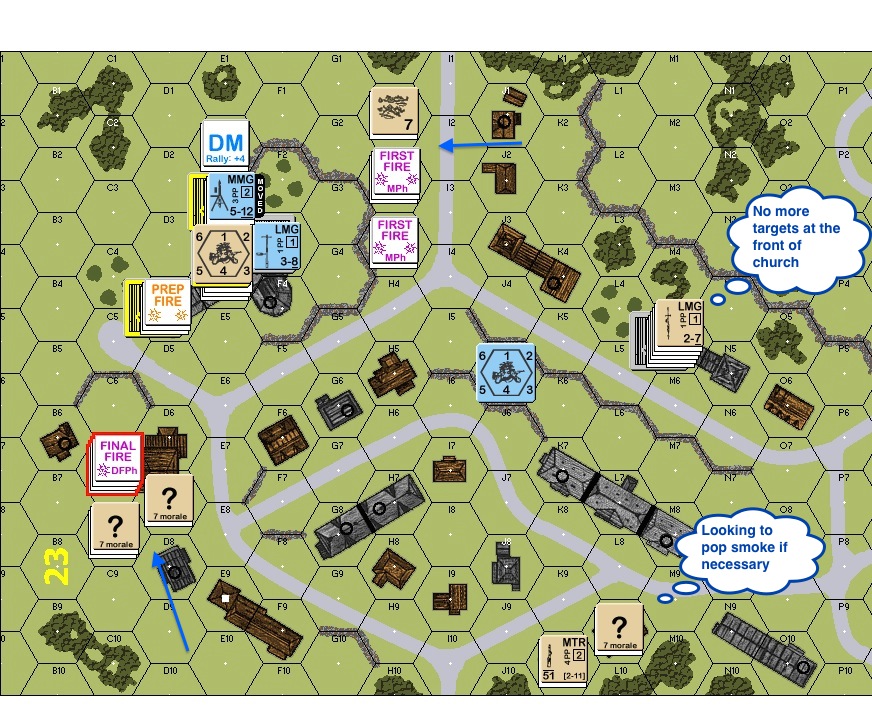
This was the Canadian Turn 1 : the Canadian death star contained a heavy machine gun (“HMG”) that went on a long rate tear, obliterating the east side of the church  A team of Canadians rushed forward from the northeast.  Another team moved around to the south-west of the church to catch Germans routing to that side.

ASL105-GT2a-proc

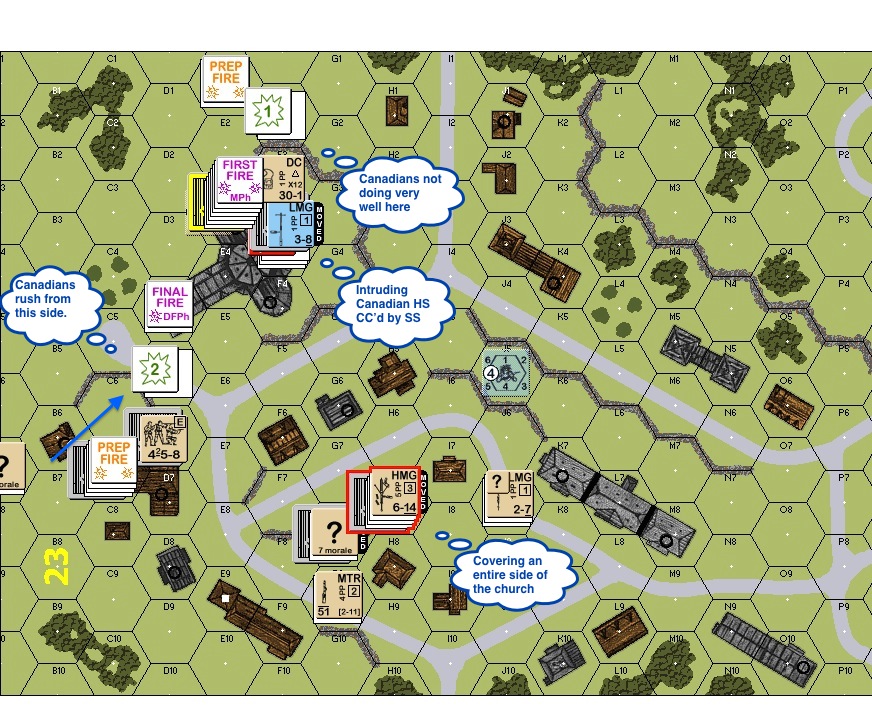
This was the German Turn 2 : the Canadian death star continued to work on the east of the church.  Canadians move closer from the northeast and the southwest.

ASL105-GT3a-proc

This is the German Turn 3: a half squad attempted to approach the church with a demo pack earlier but was routed.  This was the first attempt to retrieve it.  The half squad (“HS”) was then KIA’d, as were a number of other Canadian units afterwards.  The Canadians never got this demo pack back.  The Canadian death star decided to relocate for lack of targets.

ASL105-CT4a-proc

This was the Canadian Turn 4 : The Canadians didn’t do very well on the east side.  The lone intruding HS crashed into the church but was immediately met with the SS in close combat!

ASL105-GT5a-proc

German Turn 5 : Even though the odds of that mêlée was turning because of reinforcing Canadians from all sides.  The Germans were still blocking one of the staircases while the rest raced upstairs.

ASL105-CT6a1 - KIA Demo-proc

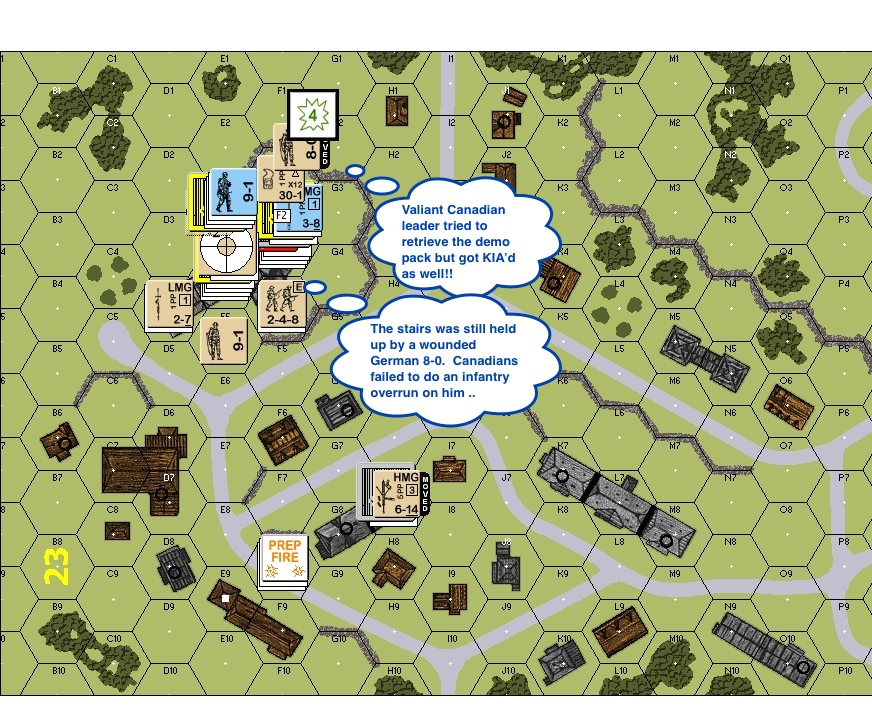
Canadian Turn 6 : A valiant Canadian 8-0 made a desperate try for the dropped demo pack and was killed as well.  The mêlée hadn’t ended.  Scores of Canadians were held up by a wounded German 8-0 at one of the staircases!  Someone suggested an infantry overrun on the wounded German but the Canadians failed to act.  It was just too crowded and they were afraid that they might shoot their own.  The Canadians rushed up the other staircase in frustration.

ASL105-End-proc

Last German Turn : the Canadians were able to dispatch the wounded German 8-0 at the end of the previous turn.  All German upstairs were then immediately encircled!!  The Canadian laid heavy firepower on the Germans inside the church.  The HMG went on a rate tear as well!  However when the smoke settled, one German HS remained.

The Canadians ran out of time.

Journey to a Tourney, Part 3 : The Aftermath

M36 JacksonI never expected this, but there IS an “aftermath” to having done a tourney for the first time :

  • Having prepared for all 25 tourney scenarios, I read a lot more of the rulebook and the scope of scenarios I can play expanded.
  • I met some great folks around the region as well.  I have a few more regular “Live” games now on VASL apart from my usual stable of PBeM (“Play By eMail”).
  • I play a little faster.
  • I play differently too, having seen different styles of play.  For example :
    • I know I should be more aggressive with my movements.  Moving and encircling is way more effective (and time efficient “turn wise”) than sitting and shooting.
    • I know what establishing a tempo as an attacker feels like.
    • I don’t care about the die rolls anymore.  “Reversion to Mean” dictates that it will all even out at the end.  Good decisions win the game not die rolls.
    • I overheard Ian Percy and George Bates said (and this is far from an exact quote) : “it’s not so much about what you do, it’s more about presenting your opponent with a serious of tough decisions and one way or the other, he’s going to mess a few up.  Make him do all the work.”
    • It’s important to plan out where you should be on the map and also when you should be where on the map especially as the attacker so you don’t run out of time.
    • There was an earlier poll on GameSquad asking whether folks are more comfortable attacking or defending in a scenario.  I can’t find it now but someone said “Is there a defence?”.  This thought rang in my head during my last round as the IJA (Imperial Japanese Army) defender in J116 Brigade Hill.  The IJA were infiltrating and cutting the attacker’s rout paths.  My understanding of Book VI (“Defence”) in Clausewitz’s “On War” echoes the thought : defence is just a different form of offensive action – counterattack!
  • Now I am getting ready to support the Hong Kong Society of WargamersAdvanced Squad Leader Tournament this year!!

Lastly I want to share something from the tourney with everyone.  John Charles Knowles, who’s teaching me jungle warfare through Operation Watchtower at the moment, wrote a cheat sheet for the PTO for our benefit.  Here we are :

Malaya Madness Chapter G Cheat Sheet

Cpl Kwan 7-0

A33 Tettau’s Attack AAR

http://www.defendingarnhem.com/commanders.htm

Lt General Hans von Tettau

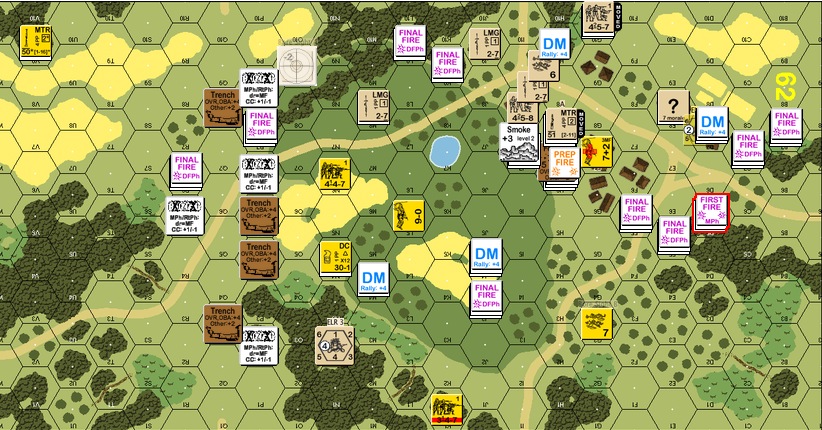
A33 Tettau’s Attack puts us right back into Arnhem, 18 September 1944.  The Red Devils had landed and various German units were on the counter attack.  Lt General Hans von Tettau and his hastily gathered battle group was tasked with attacking the British drop zones.

The Germans got a mix of conscripts, a big lot of second line squads, a first line squad and 3 leaders.  They were SS but was in reality a group of camp guards and depot troops(ELR:2).  The Scots got only 4 elite squads, 3 leaders, a medium machine gun (“MMG”) and some LMGs.

The Germans win by exiting 3 victory points worth of units to the right of the map in 11 turns.  A squad is 2 points, a half squad 1, a leader 1 and each leadership modifier exited is 1 (hence a 9-1 leader is 2 points).

BT1a-proc

I played the Germans against a gentlemen who’s recently coming back to Advanced Squad Leader (“ASL”).  The superior troops and machines of the Scots were deadly over that much open ground.  I split the Germans into two.  The regulars were to make their way across the grain field to the left where the woods offer cover down most of the map.  The MMG went into the wooden building to suppress the Scot MMG and to hinder the Scots from shifting their troops to the left.  The conscripts were on the right and their goal was to draw fire as I was not optimistic about them moving down the right in time with their movement rate of 3.

GT1a-proc

This was the German Turn 1.  The regulars dashed over to the far left of the field (top of the map).  The Scot MMG went on a horrifying rate tear.  The Germans kept their heads down and ran.  When it’s all over, the Germans KIA’d 2 squads with another squad broken.
GT2a-proc

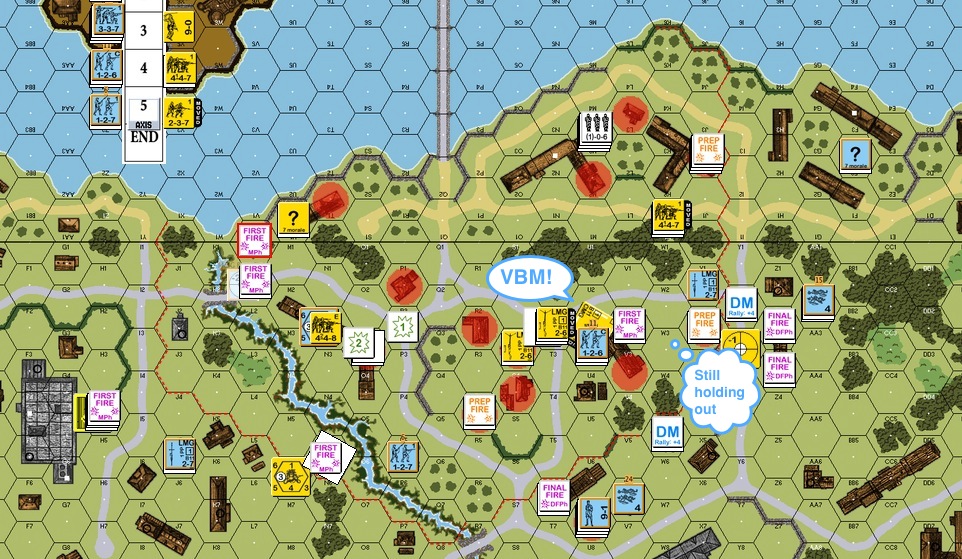
German Turn 2 : The survivors on the left flank (top of the map) pushed into the Scot LMG team.  One German half squad got too close and was vaporised.  The conscripts on the right (bottom) got a lucky break when the Scot 9-2 with the MMG team broke.

BT3a-proc

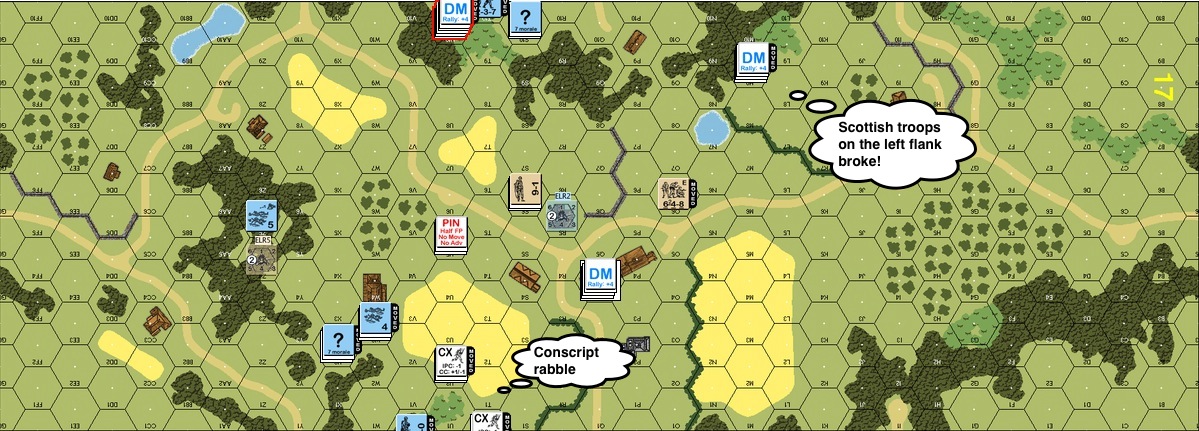
British Turn 3 : More lucky breaks for the Germans!!  The fire group formed by the surviving Germans broke the Scot LMG team on the left!  The conscripts rabble on the right made very little progress through grain field.  However they served their purpose by drawing the Scot’s attention.

GT3a-proc

German Turn 3: The Germans were not going to let the Scots on rally on the left flank.  They shot and they ran after the routing Scots on the left flank.  The Scot 9-2 (MMG team) rallied and the grain field on the right was covered with German conscripts too scared to run.  However, the Scots started to realise something was not quite right.

GT4a-proc

German Turn 4: the Germans on the left flank caught up with the routing Scots and killed them.  A German 8-0 with a LMG decide to stay back, scrambled into the wooden house and lay fire lanes to hinder the pursuing Scots.   The rest of the Scots started running back and the German on the right flank tried to slow them down with long-range shots.  Meanwhile a pair German leaders on the right broke off and started running toward the right of the map for a few more Victory Points.

BT5a-proc

British Turn 5 : the German 8-0 with LMG was a rather effective rearguard.  The running Germans focused on putting walls and hedges behind them as the Scots couldn’t see over unless they came right up against these structures.

GT5a-proc

German Turn 5 : the Germans need to get at least a squad and a half over the wall before the Scots recover.  The German leaders on the right flank were also scrambling for the exit just to make sure.

The closest Scot units were broken up against the wall.  All hopes were lost for the Scots as another two German units jumped over the wall after their friends.

Or was it?

BT6a - shot back snakes-proc

British Turn 6: A Scot 9-1 leader rallied!  He dusted himself off and clambered over the hedge after the Germans.  His sights were on the LMG the German left behind.  Yes, that German 8-0 with the LMG just made it over the far wall.  May be he won’t turn around …

But he did.  The German 8-0 turned around and slammed the LMG on the wall he just jumped over.  He took a shot through the orchard hex which hindered his sight.  He had to make this shot because otherwise the Scot leader would dive into the woods behind the building with the LMG.

He rolled snake eyes ..

And the valiant Scot leader failed his morale check and hit the dirt.

The Germans ran off.

Cpl Kwan 7-0

Journey to a Tourney, Part 1: Decisions

I did it.

I registered for my first Advanced Squad Leader tournament, the Malaya Madness (Feb 21 to 23 2014) in Singapore. I bought my plane ticket. I booked my hotel.

Two months ago I never would have even thought about it. (Flying to Singapore for a weekend to do what?!!) A year and a half ago, Advanced Squad Leader (“ASL”) wasn’t even a blip on my radar.

Before I go on, I want to make one thing crystal clear:

  1. If you are a relatively new player,
  2. If you are a “dormant” ASL player who’s quietly learning and playing ASL by yourself,

I am writing to you.

I know there are a lot of you out there and I care to guess that doing ASL by yourself is not the easiest hobby to do. I am writing to you. I would like to share my rationale for some of the decisions I made along the way.

I hope this helps you with your choices.

So there I was, working through the Infantry rules in my room, flipping through the massive 2nd edition Advanced Squad Leader Rulebook. I was highlighting important texts and I was noting important ideas in the margin. I was studying hard. When I got tired, I played a few rounds of ASL solo, planning to play through each scenario in turn.

Even playing was slow going, I found myself re-reading the rulebook more than I was playing.

Question 1: Do I keep on studying the rulebook or do I dive straight into a game?

I looked for live games. I found the folks at the Hong Kong Society of Wargamers who have face-to-face (“FtF”) games very weekend. Getting experienced players to take you through ASL games shows you the rules in action. It gives you context. The rulebook becomes much easier to read.

Oh yes , in case no one told you :

  1. Don’t wait to read and study the rulebook and “be ready” before you play your first game. Just go look for live games and attend. I have never met an ASL’r who’s not willing to teach.
  2. No, you don’t have the read the whole rulebook. You can start playing infantry only scenarios after Chapter A.

Question 2: Do I keep on dabbling solo or do I get on a regular play schedule?

I attended live games with the Hong Kong ASL’rs, but I couldn’t have joined them every weekend. ASL was still a solo affair for me. Had it continued in this fashion ASL might have become another of my passing fancies.

It never did.

Out of the blue Don Lazov wrote and asked me if I want to learn ASL from him. I was going to keep my “ASL hobby” on a personal level. but here I was, there’s an experienced player offering to teach. Do I keep it a private & low pressure affair or do I get serious about this?

Anything worth doing is worth doing seriously.

I stopped thinking and said “yes”. That decision changed my ASL life. ASL went from a private study to a social affair. Playing intelligent and thoughtful human beings makes ASL come alive from that moment on. ASL becomes the complex and rich experience that it’s designed to be.  Having a regular play schedule helps me internalize the rules.

Question 3: Do I stick with PBeM or do I play live?

I play ASL via PBeM using VASL. What I mean is that I play ASL via exchanging logs generated from Rodney Kinney’s “Virtual ASL” platform. I was up to 9 concurrent games at one stage. PBeM saves me from having to be at appointed places at appointed times. With my work travel schedule that was simply beyond the realm of possibilities. I step through my opponent’s moves from the logs they send me.  I interject my responses and I send my logs back.

What I lost was the social interaction. What I have was perhaps too much time to consider and to reconsider my moves. PBeM games allow for methodical and well thought out games, perhaps too well thought out.

So I started having more live VASL games where I see my opponent’s moves real time and we interact via Skype. Often times another friend(s) drop by and it becomes a virtual club night! I still travel as much but I keep a regular live VASL schedule now.

My other mentor, Witchbottles, a man who’s a lot busier than I am said it’s a matter of time management.

I am learning to play faster. I also learn to give up the notion of playing a “perfect game”. I am learning to square up a situation, structure a solution on the fly and execute!

Play, laugh and have a great time.

Question 4: Do I stay “in the shadows” or do I go signed up for a tournament?

I heard there will be an ASL tournament in Singapore for a little while before it was announced. I have to admit I didn’t give it any thought. The idea of paying for flight and hotel to Singapore by myself just to play boardgames was crazy. I didn’t even join the one in Hong Kong last year (I haven’t turn Fanatic then)!

Both of my mentors said I MUST go. One of them had even said in the past that he doesn’t go to tourneys anymore. He said I should go and decide for myself.

I gingerly broached the topic with my family. I have to admit, it feels like telling them that I am joining a motorcycle gang. My beautiful family was incredulous at first but quickly came around and gave me the support I need.

I signed up for my first ASL tournament.

Do I have a chance in hell of winning anything? No, but that’s not the point, although they do have a prize for the one who lose the most games.

To me the points are :

  • This is my gesture to myself that I want to do ASL well. Anything that’s worth doing is worth doing well. I might not become a world class player but I want to be wicked good and a lot of fun to play.
  • This is me reaching out and be part of the Asia Pacific ASL community. These are the core group of guys I’ll be playing countless hours of ASL with for years to come.
  • This is me supporting efforts to foster and to grow the Asia Pacific ASL community. Today I already count among my regular opponents, a player from Singapore and a player from Japan. I look forward to a lot more!
“Journey to a Tourney” is a multipart series that details my personal journey to what’s hopefully the first in a long line of regular ASL Tournaments in Asia Pac. I hope this will encourage any new or experienced players to come join us as well!

References :

AP54 800 Heroes AAR

AP54 800 Heroes is the second scenario I played that is designed around the Battle for the Sihang Warehouse in Shanghai.  The first one I played was A110/ASL13 Shanghai in Flames.  I believe there’s at least one more : BFP31 Chinese Alamo that covers the same battle.  The subject matter’s the same but the scenario designer’s treatment is very different.

The date was 29 October 1937.  The Imperial Japanese Army (“IJA”) had made successful incursions into Shanghai.  Most Chinese units had retreated and the western powers were uninvolved at this stage.  Chiang Kei Shek (the Generalissimo) was determined to keep the battle in world’s view and hence decided to keep the fighting in Shanghai which was already an international city at that time.  Sihang Warehouse had the distinction of being right across a stretch of water from Shanghai’s International Concessions.

It was  the place where Chiang wanted to bring China’s struggle to the world’s attention.  A battalion from the 88th Division, a German trained élite unit was hence given the task and so the name “the lost battalion” as they were the last to leave.

AP 54 Setup

Witchbottles played the Chinese defenders and I the IJA.  This was a training game and the great tactics on both sides were his and the bad ones mine.

This was the setup.  The IJA were free to setup certain units to the right of the map or enter via the North (top) or the East(right).  IJA tankettes didn’t have radios and were therefore setup in platoon formations.  The building to the lower left of the map was the warehouse (factory) and was fortified.  The red ring denotes the area where Chinese units were fanatic.

This is a 5.5 turn game.  The victory conditions for the IJA were either to control the warehouse or to control 3 or more hexes of the warehouse plus all other buildings in the Chinese setup area.

AP54-JT1a

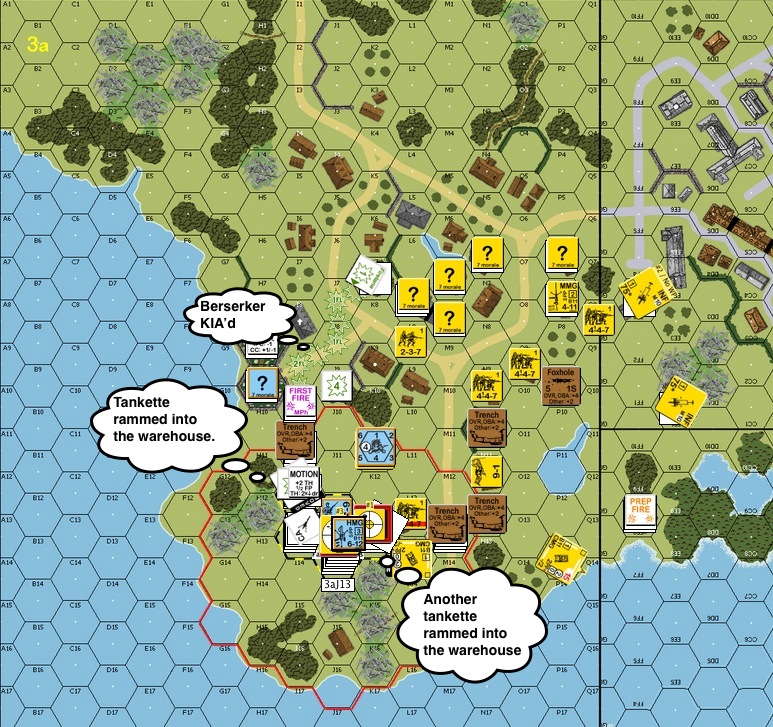
IJA Turn 1, the first thing the IJA needed to deal with was the heavy machine gun (“HMG“) sitting on the top of the warehouse.  After laying down white phosphorus and smoke, two tankettes started coming in from the north.  After bypassing some buildings, the world exploded around one of the tankettes.  It was a set demolition charge!  What both sides didn’t realize at the time was that set DCs don’t affect AFVs (armored fighting vehicle).

Suddenly, an IJA soldier in the woods to the right yelled :

BANZAAAAAAI!!!

The IJA worked out an Armour Assault together with a Banzai charge out of the woods.  The IJA thought if they could cut off the line of trenches from the base they might get a chance to stop the Chinese squads from retreating back into the warehouse.  An 8-0 IJA leader and his squad wandered out of the smoke cover and were the first to be met with a hail of bullets from HMG on the roof.  The group disintegrated on open ground.  The rest of the charge hug closer to the tankettes and kept on.

AP54-JT1b

A tankette overran a Chinese trench, and a IJA squad piled in.  The tankette bogged but the Chinese squad was pinned from the shock.  Pinned as they were, they survived the overrun attack and shot at the rear of the attacking tankette.  The LMG broke and so did the men, the Chinese squad broke and ran towards the warehouse.

AP54-CT2a

This was the end of the Chinese Turn 2.  The defenders took advantage of the IJA smoke.  A Chinese squad ran across the warehouse floor and threw out a demolition charge.  “CANDYGRAM!!” they yelled.  The explosion striped the approaching IJA squad who caught a DC on their laps a moment ago.

AP54-JT3a tanks went in on both sides-proc

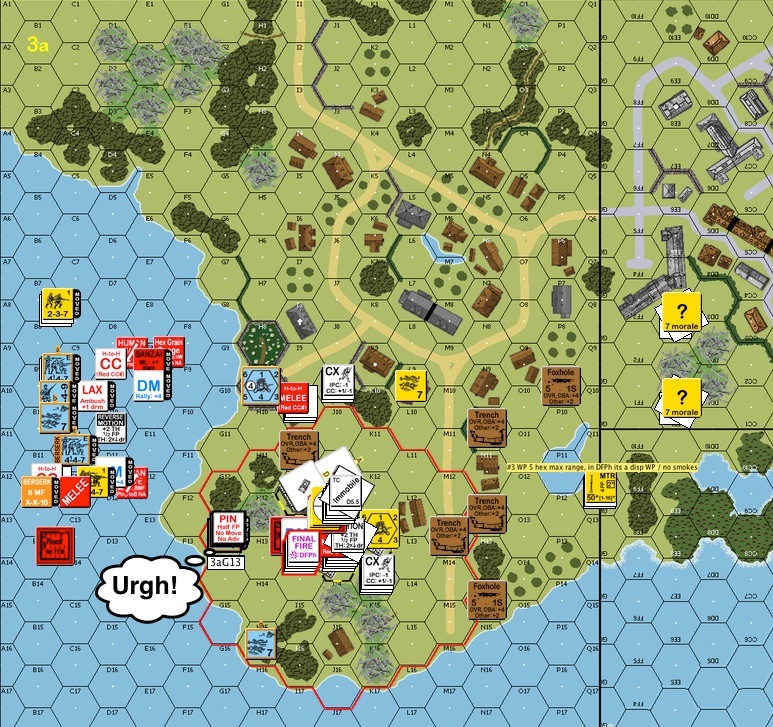
Turn 3 IJA saw a half squad going berserk on the top left of the warehouse perimeter.  It drew fire well but got blown promptly out of existence.  An IJA tankette then smashed into the fortified warehouse on the left flank.  It was greeted by a squad on the warehouse floor.  An 8-1 leader stood a little way off.  He waved at the IJA tank and smiled, pointed at the squad and said …

“Meet my Dare Death squad.”

The Dare Death squad went berserk (PAATC free), slammed a DC charge onto the IJA tankette and set it off with maniacal grins.  BOOOMMM!!  The Dare Death squad survived but so did the tank.  The dust settled and the 8-1 leader was still there.  He said

“I am happy you survived, because I also prepared this for you entertainment pleasure.”

A little way behind him was a medium machine gun squad, and they blazed away.  On the third shot the IJA tankette exploded.  Another IJA tankette slammed into the right of the warehouse as well, one tankette in the face of 3 machine guns.  Please do not for a second mistook my blissful ignorance of tank rules for bravery though.

Nonetheless, two breaches were made in the fortified warehouse and close combat ensured on the right of the warehouse after the defenders immobilised the tankette.

The Chinese piled a hero and a berserker into the melee.  Another squad tried to creep up on the IJA tankette sitting outside so that they can blow it up before it too slams into the building.  Unfortunately the squad was shot in the rubble outside.

AP54-JT4a

IJA Turn 4 got even more intense.  The tankette on the right make another breach in the warehouse.  The tankette to the north was shot and killed by an MMG before it could hit the warehouse walls.

IJA troops from the north finally made it to the perimeter.  At Witchbottles’ suggestion, they decided that a Banzai charge was in order!!

AP54-JT4b

This was the situation after the Close Combat phase.  The IJA killed all defenders in 2 out of 3 hand to hand combats inside the warehouse.

AP54-CT4a

Chinese Turn 4!  The reserve unit that slipped outside earlier tried to make its way back into the warehouse.  Unfortunately it broke under a hail of IJA gun fire and was pinned outside.

This is where the story ends as the Chinese didn’t have enough bodies to take the warehouse back.

In reality, the 423 Chinese defenders held out for another two days.  They succeeded in winning international attention to the Sino Japanese war.  The British allowed them to retreat across the New Lese Bridge into the International Concessions.

The Sihang Warehouse still stands today.

What thoughts do you have?  What would you have done?  What are your experiences playing this scenario?

Please comment!

Sihang Warehouse looking from the other side o...

Sihang Warehouse looking from the other side of the Suzhou River. October 2006 (Photo credit: Wikipedia)

BoF1 The Marco Polo Bridge Incident AAR

Manchuria

This was 1937.  Since the first Sino Japanese war in 1894-1895 fought over the control of Korea, Japan had since shown astonishing successes in modernising their armed forces, cumulating in the defeat of the Russian navy in the Battle of Tsushima strait.  By 1937 Japan was in control of the vast natural resources in Manchuria and sat at the gates of Beijing.  Engagements between China and Japan so far had been isolated incidents.

Until the Marco Polo Bridge.

Marco Polo Bridge was “Lugouqiao” in Chinese.  Since it happened on July 7 and opened China to eight years of hell that was the Second Sino-Japanese war, every Chinese kid learned of this incident as the “Seven Seven Lugouqiao Incident“.

Marco Polo Bridge

There are two scenarios called “Marco Polo Bridge”  according to ASL Scenario Archive  one of which is BPF28 included in “Blood & Jungle”.  The one I played with Takezo was BoF1 The Marco Polo Bridge Incident.

IJA Turn 1

North is to the right of the map.  This scenario started with the Imperial Japanese Army (“IJA”) setting up within a 2 hex radius of the east end (“bottom side”) of the bridge.  The Chinese (“KMT” or “Nationalists”) got some token troops but reinforcements enter rapidly on Turn 1.  The IJA got 2 tankettes and a couple of squads on Turn 3 coming down the bridge.

The IJA wins by taking at least 12 buildings within a 7 hex radius (thin red line) of the east end (“bottom” side) of the bridge.  Every prisoner the IJA captured lessens the victory requirement by 1 building.  Every tankette the Chinese destroyed increases the victory condition by 2 buildings.

Chinese Turn 2

Anyone who read Ramón Real Bernal’s AAR Marco Polo Bridge Incident BoF1 vs Pakko Belmonte (IJA) will recognise my Chinese setup.  The IJA would no doubt be grabbing as many buildings as possible on the first turn.  The Chinese need to hold out until their reinforcements arrive, which was tough considering a third of the reinforcements were conscripts and they marched slow.  The Chinese need to limit the IJA land grab and yet not get close enough to be captured.  The above picture was the Chinese Turn 2.  The Chinese got a medium machine gun (“MMG”) setup with a leader on the 2nd level in the big stone building on the left.  The intention was to limit IJA movements.  However as it turned out, it was too far from most of the action and there were too many blind hexes among the buildings.  The Chinese armoured car sporting two coaxial machine gun turrets arrived at the bridge over the stream.  The Chinese squad in the big “T” shaped wooden building was already captured by Turn 2.  Chinese reinforcements attempted to rush a couple of the IJA buildings but were beaten back.  On the far right you can see two stacks making their way to the river hoping to hook around the rear of the IJA positions.

IJA Turn 3

This was IJA Turn 3.  The IJA reinforcement came over the bridge.  The MMG perched on the stone building to the left opened fire but to no avail.  The IJA tankettes rolled into town, seeking to plug what my opponent saw as a crisis point : where my Chinese reinforcements threaten to hook around on the far right.

The lead IJA tankette rolled into view around the woods and the LMG squad at the end of the street threw off their concealment, opened fire, got a side shot and blew it up!  (See “A Moment in ASL : LMG vs Tankette”)

Chinese Turn 3

In the next Chinese turn, the IJA continued to hold out well.  Chinese squads kept breaking before they could be productive.  My brains must have frozen because I should have conducted an armoured assault from the left with the armoured car to distract and to encircle the IJA.  Meanwhile the squads to the far right were more successful in drawing IJA forces off the center.  The armoured car had instead moved to stop the IJA reinforcements from joining the fight in the middle.  I was hoping to risk bogging, run the armoured car across the stream and “freeze” some of the guns in the middle clump of buildings so that Chinese squads could cross the street.  That never happened since the crew, lacking a radio, didn’t want to move again before the game ended.

Chinese Turn 4

The Chinese went all out in Turn 4.  They finally started moving in cautiously from the left as well.  They couldn’t make any inroads to the semi circular clump of buildings in the center but they managed to break into the “T” shaped wooden building.  May be now the Chinese could cut into the woods, cut off the IJA on the top of the map and get to the prisoners held by the river?  The Chinese squads on the far right ended the charade and turned left, looking to capture the little stone building to the right of the “T” shaped wooden house.

IJA Turn 5

This was the last IJA turn.  The IJA reinforcements, although harassed by the armoured car, managed to get into the wooden buildings to the left of the IJA perimeter.  The IJA in the middle counterattacked, assisted by a “vehicular bypass freeze” of the occupying Chinese squads.

Chinese Turn 5

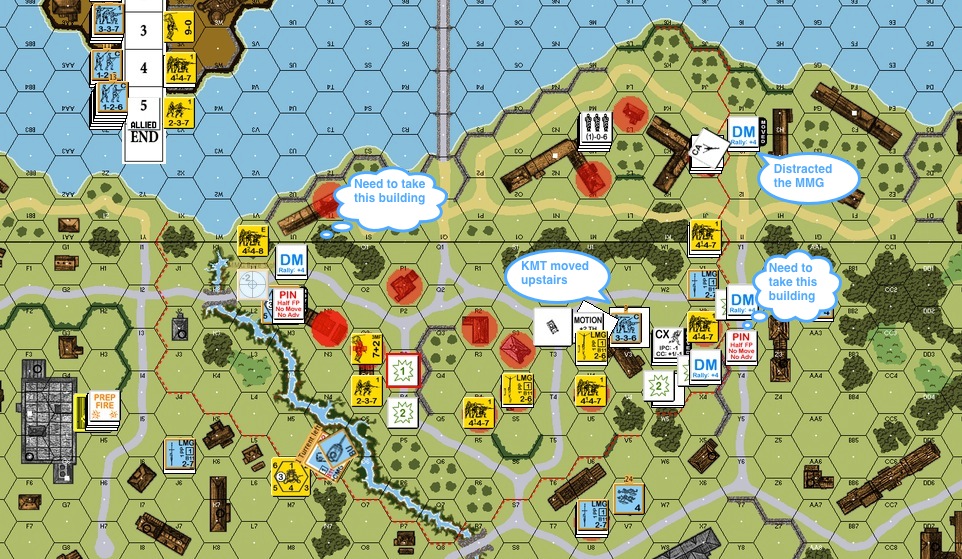
This was the last Chinese turn.  The Chinese needed to either kill the tank or to take two more IJA buildings to win.  The Chinese conscripts in the “T” shaped building hopped upstairs to avoid gunfire and to deny the IJA control of the building. The squads on the right used some conscripts and a leader to distract the IJA MMG while the rest rushed the little stone house again. They were unsuccessful, and their compatriots on the far left was broken crossing the street, not being able to capture the other building needed to snatch a Chinese win.

So here we were, truthful to the historical turn of events, the IJA gained a beachhead on the east side of the Marco Polo Bridge and marked the start of the Second Sino Japanese war.

If I were to play this scenario again I would move the MMG from the big stone building (building H4) on the left to the big stone building on the bottom of the map (building W8). Having it in “building H4” gives you opportunities to snapshot at the IJA as they go from building to building. However it was out of normal range to most of the buildings in the zone of contest. Putting the gun in “building W8” would put it in play for most of the game.  I would also use the armoured car more along with a couple of squads from the left side of the map.

I am sure some of you must have played this before, or have thoughts about what you would have done.

Please leave me your thoughts!

DB099 The Gin Drinker’s Line AAR

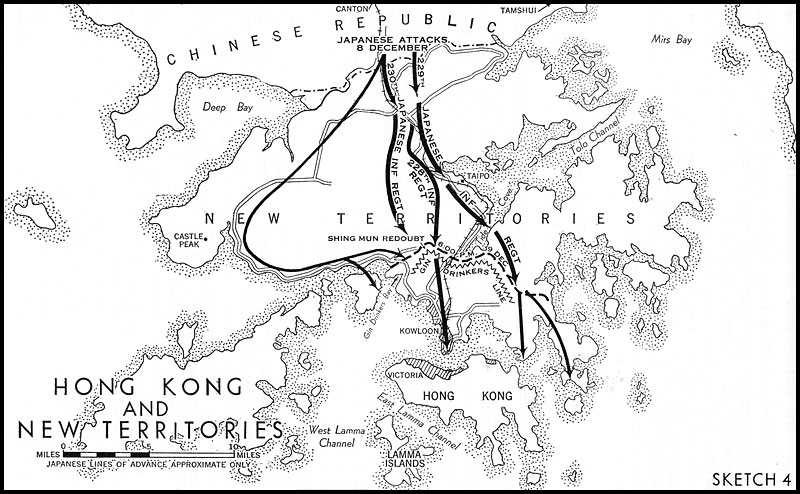
During the night of 9 Dec, Japanese troops mounted a massed attack on the western portion of the defensive line, and the Gin Drinkers’ Line collapsed by 10 Dec. On 11 Dec, as Japanese troops advanced southward along the Kowloon Peninsula, Maltby ordered the evacuation of all troops to Hong Kong Island.

– C. Peter Chan, Battle of Hong Kong, World War II Database

The Gin Drinker’s Line

This latest scenario is from Dispatches from the Bunker, dated Dec 10 1941 and centered around the breakthrough of the western part of the “Gin Drinker’s Line” which led to the siege of Hong Kong island.  (Hong Kong surrendered on Christmas Day, 1941.)

British Turn 1

Erwin played the Imperial Japanese Army (IJA) and I the Rajputs of the British Indian Army.  The above illustration is the British Turn 1.  The IJA had already initiated their advance from the west.  The IJA’s winning condition was to amass more “victory points” (ie kill more) than the British and to occupy 5 or more huts (“the village”) on the top right of the map.  The two “TI” units you see are a mortar unit and a medium machine gun (‘MMG’) unit trying to dig foxholes in a grain field, looking to dominate the depression and to slow the IJA advance to the huts.  You can see also where the mortar bore-sighted  (the semi-transparent marker on the top left) and where the MMG bore-sighted (bottom right).  The IJA could choose to have reinforcements coming in from the top left of the map in Turn 2 or from the bottom right of the map in Turn 3.  In retrospect I should have weighted my defence more toward the top of the map where the approach to the huts was shorter.

IJA Turn 2

This is IJA Turn 2.  The IJA was already rushing the Rajput trenches.  There was a Banzai attack on the top left of the map where 2 IJA squads and a leader ran through all defensive fire and into a trench with a solitary Rajput squad.  These Rajputs fought valiantly and with their last gasp took ALL the offending IJAs with them in brutal hand to hand combat.  (Note to self: never put too many squads into a HtH, kill odds for BOTH sides are good.)

British Turn 2

The British Turn 2.  The IJA had already crumbled the top side of the Rajput trench defence but now it was clear that the IJA reinforcements would not be coming from the top left but from the bottom right on Turn 3.  The Rajput mortar squad fired off a smoke round to block the IJA mortar crew and the MMG crew on the opposite side of the depression.  The Rajputs from the trench line were in full retreat, desperately running across the depression.  The orchards in the depression provided a fair bit of cover.  The MMG squad was still trying to dig their fox holes amidst all the action upfront.  You should also see a British squad pinned on the bottom left before it could get into the depression.  These guys won’t survive the engagement.

JT3a-proc

IJA Turn 3 : The IJA was going for blood!  The IJA reinforcements appeared on the bottom right of the map.  The orchards provided good hindrance for them. In the meantime, the mortar and the MMG squads were busy firing away, as did the retreating squads in the depression.  The IJA arrived at the edge of the depression.  They were also on the verge of overrunning the routing Rajputs in the woods on the top of the map.

IJA Turn 4

IJA Turn 4 : the Rajput mortars took out an IJA 9-1 leader and a crew in the preceding British turn from across the depression with an airburst and so the IJA decided that it was time to lay a smoke round on them.  The MMG squad finally got their foxholes in the preceding turn.  You can see the IJA reinforcements coming to the woods line immediately south of the village (on the right of the map) where the IJA sniper broke the LMG crew in the hut on the south-eastern tip.

British Turn 4

British Turn 4 : this was the last chance for the Rajputs to prepare for the inevitable IJA onslaught.  The game teetered on a balance at this point.   In the middle of the village, the IJA smoke round actually protected the Rajput mortar as it relocated to prepare for a last turn IJA rush.  The MMG in the foxhole kept the 3-hut cluster relatively clean (it would kill the injured IJA leader).  You can also see the IJA already moved into the Rajput LMG position on the south end of the village.

IJA Turn 5

Final IJA Turn : The good news from the last British turn was that the IJA fired at the broken stack in the hut on the north-west tip of the village and granted the Rajputs a battle hardened élite squad!  In this last IJA turn you can see all the residual fire on that corner of the village, evidence of the élite Rajputs (and the mortar squad) fighting hard.  The IJA broke into the south side of the village unfortunately.  Even though the Rajputs routed some broken squads forward in the last turn as speed bumps, they weren’t much good in the IJA Advance Phase (having routed off already).   The IJA won this scenario when the dust settled with a 1 point lead in VP and five huts secured.

To be honest, I didn’t read and understand the Victory Conditions properly.  I thought the IJA had to get more than 5 huts so I biased my defence towards the northwest of the village.  I was going to let the IJA have five huts but deny him the rest.  I succeed at that but unfortunately all they needed was 5.

If I play this scenario again, I will bias my trench line defence to the top of the map.  It’s also important that the trench line Rajputs retreat as fast possible to help with the village defence.

This was a tight scenario all the way to the end.  The action was brutal, the fight was desperate and the body count high.  For those who wants to experience PTO without the PTO terrain, this is a top notched scenario.

By 13 December, the 5/7 Rajputs of the British Indian Army commanded by Lieutenant Colonel R. Cadogan-Rawlinson, the last Commonwealth troops on the mainland, had retreated to Hong Kong Island.

– “Battle of Hong Kong“, Wikipedia

jaL80

English: Entry of the galleries from Shing Mun...

English: Entry of the galleries from Shing Mun Redoubt, part of the Gin Drinkers Line in Hong Kong Français : Entrée de l’une des galeries souterraines de la Shing Mun Redoubt qui faisait partie de la ligne fortifiée Gin Drinkers de Hong Kong (Photo credit: Wikipedia)

Rajput Regiment

Rajput Regiment (Photo credit: Wikipedia)

A Moment in ASL: LMG vs Tankette

Type 94 TK tankette captured at Battle of Okinawa

Type 94 TK tankette captured at Battle of Okinawa (Photo credit: Wikipedia)

So I perched on the side of a skating rink today, returning a PBeM log on BoF01 The Marco Polo Bridge Incident.

Two IJA (Imperial Japanese Army) tin cans drove down the bridge on Turn 3 to stop the Chinese from threatening their rear. As the lead tin cans drove around the woods, a Chinese squad unconcealed and started up with their light machine gun (LMG).

The range was 6 hexes.  I needed to roll a 10 to hit. Moving target and the brief appearance added 4 to the dice roll (Case J), the size of the tiny Type 94 tank added 2 (Case P) .. I needed a 4 and I rolled 2,2!  PPOONGGGGGGGGG!!!

So I got a hull side hit where the armour’s zero. I needed another 4 or less to kill it (2 rolls of 4 or less is a 2.9% probability).

It was a 1,2 – BOOM!  The Chinese LMG took out a Japanese tankette!!

JUST HOW COOL IS TTTHATTTT?

SP7 Delayed on Tiger Route – “Not One Shall Be Forgotten”

http://www.historyofwar.com

Operation Market Garden: British 1st Airborne Division, 17-21 September 1944 from “Military History Encyclopedia on the Web”

Heelsum to Arnhem

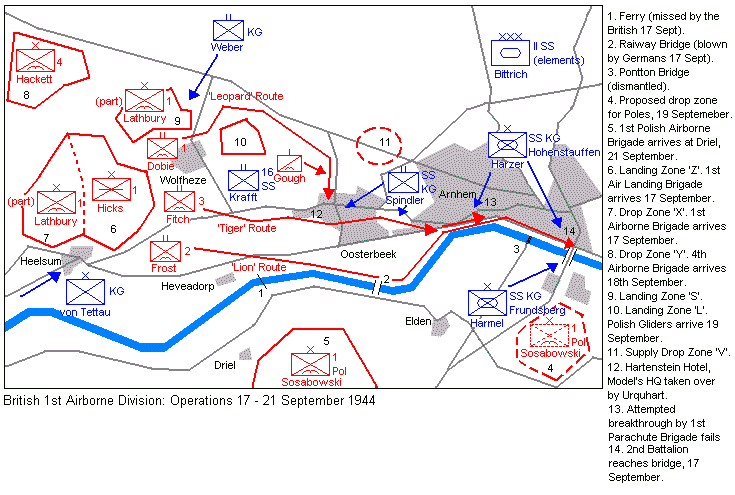
On September 17 1944, the first day of Operation Market Garden, the British dropped 3 battalions of the 1st Parachute Infantry near Arnhem.  Their approach routes were designated “Leopard”, “Lion” and “Tiger”.

The 3rd Battalion ran into Major Sepp Krafft’s SS Panzer Grenadier Depot and Reserve Battalion 16 (a training battalion) on the “Tiger” route.  Krafft quickly organised and met the British paratroopers with a defensive block immediately.

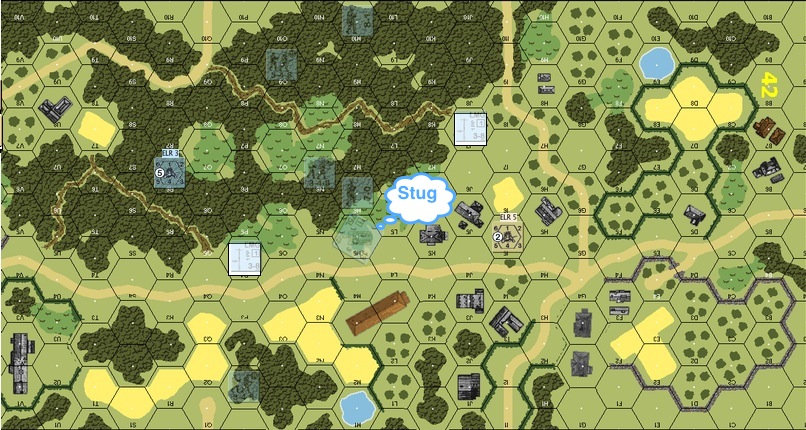
This scenario uses board 42.   The British are to move west to east through the length of the board.  The top (northern) half of the board is woods, breaking into orchards about 2/3 of the way to the east.  The bottom (southern) half is a small town.  There’s a road that runs from west to east and cuts between the woods and the town.

The Germans setup hidden (Hidden Initial Placement).  They have half the number of soldiers the paratroopers have but they also have a StuG IIIG(L).  The British has a 6-Pounder towed by a jeep.  The British win by getting a number of people and hardware off the board.  The Germans win by delaying / stopping this travel and by raising the British victory conditions by withdrawing up to the north preferably with British prisoners starting Turn 4.  SP7 Allied Turn 1 Start

This is the German setup.  There are two routes that the British can use – one down the middle of the board and one to the north through the woods.  The temptation is to focus on the intersection and that’s where I would expect the Germans to be.  I took a gamble and decided to put my units in an ambush configuration in the woods.  The StuG’s hidden in the brushes around the center of the board.  If anything should come down this road, it would be able to shoot it once it cleared the bend.  The singular half squad in the southern was nothing more than a speed bump to keep my opponent respectful should I guessed wrong.  Being in the north also allowed me to withdraw faster, raising the victory conditions for the British.SP7 Allied Turn 2 AFPh

The paras stepped into the woods.  They were ALL in the woods!  SP7 Allied Turn 3 MPh 1st Ambush-proc

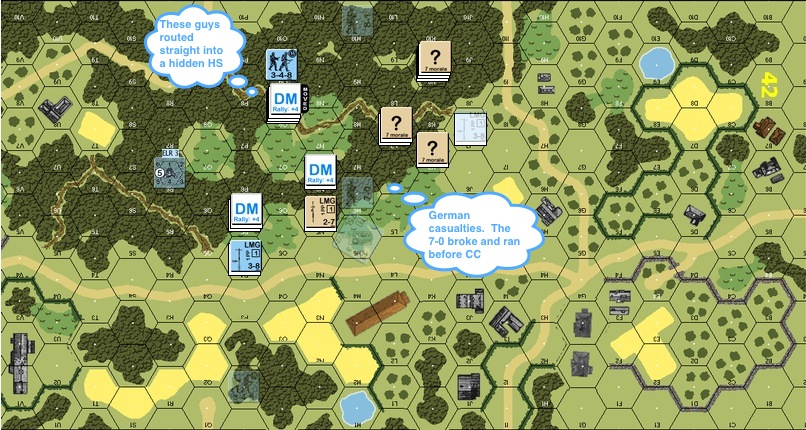
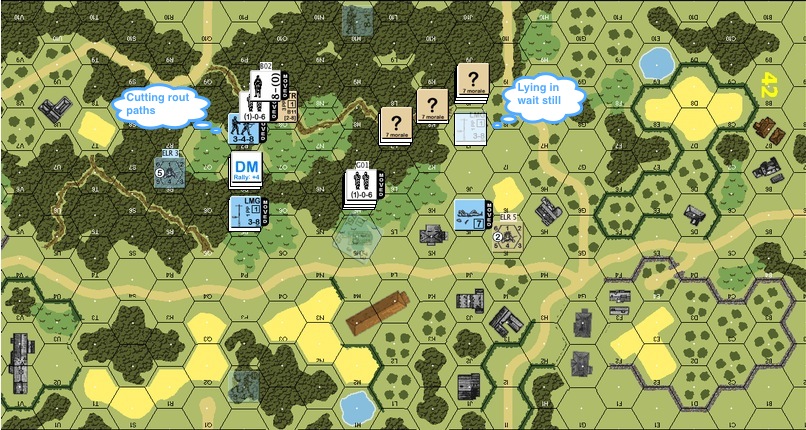
A para squad bumped into a hidden German half squad and the trap was sprung!  One of the para squads fought back valiantly and captured the German half squad.SP7 Allied Turn 3  RtPh Cutting Rout-proc

A broken para squad routed straight into a hidden German half squad who took them all prisoners.The hidden German 7-0 turned tail and routed away to avoid close combat. SP7 Axis Turn 3  RtPh Taking More Prisoner-proc

In the following Axis turn, the Germans trapped and captured more British paras in the woods.SP7 Allied Turn 4 MPh 2nd Ambush

In the north side of the woods, the other group of paras sped on.  The lone SS squad let the first stack go by and ambushed the second squad.  The third squad rushed in to help but were ineffective.SP7 Axis Turn 4 MPh Leader appear cut rout-proc

A hidden 8-0 sprung up to cut rout paths again and took more prisoners.  The jeep & gun was now around the bend, all 5 victory points worth!!SP7 Allied Turn 6 MPh Stug

It was the last round for the British and they decided to make an end to end dash across the board.  It sped by the Germans holding a captured Piat in the woods but that shot went wide.  The squad then opened up with their light machine gun and immobilized the jeep.  For a moment there they were, gun and jeep in the middle of the road.

Then the brushes rustled and the StuG appeared.

And they were blown sky high.

Copyright Alfred Robert Saak http://www.saak.nl

British 1st Parachute Battalion at Arnhem 17 S...

British 1st Parachute Battalion at Arnhem 17 September 1944 (Photo credit: Wikipedia)

English: Four Waffen SS troopers taken prisone...

English: Four Waffen SS troopers taken prisoner from 9th SS Reconnaissance Battalion at Arnhem Bridge, one is a seventeen years old. All of them are wearing the camouflage uniforms that were peculiar to the Waffen SS; these are not ‘snipers Nederlands: Vier Waffen-SSers van het 9th SS Bataljon zijn gevangen genomen bij een brug in Arnhem. Een van hen is nog maar 17 jaar. Allen dragen een camouflage uniform van de Waffen SS, het zijn geen scherpschutters zoals de titel verondersteld. (Photo credit: Wikipedia)

Sturmgeschütz III

Sturmgeschütz III (Photo credit: Peer.Gynt)