DB099 The Gin Drinker’s Line AAR

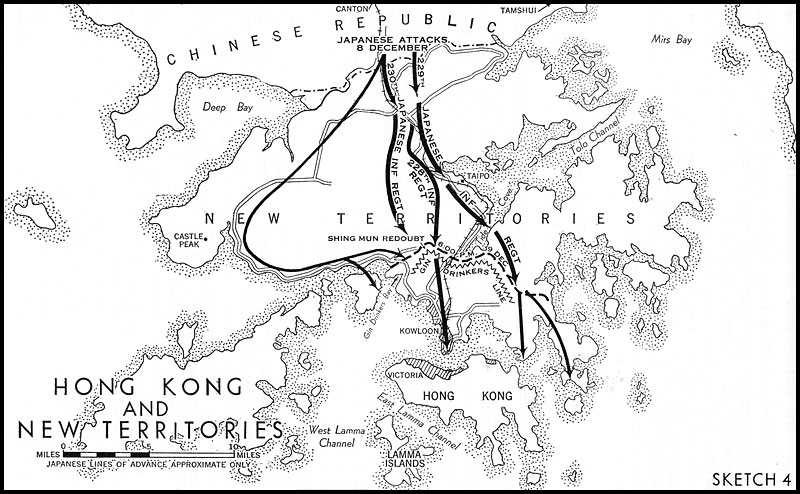
During the night of 9 Dec, Japanese troops mounted a massed attack on the western portion of the defensive line, and the Gin Drinkers’ Line collapsed by 10 Dec. On 11 Dec, as Japanese troops advanced southward along the Kowloon Peninsula, Maltby ordered the evacuation of all troops to Hong Kong Island.

– C. Peter Chan, Battle of Hong Kong, World War II Database
The Gin Drinker’s Line

This latest scenario is from Dispatches from the Bunker, dated Dec 10 1941 and centered around the breakthrough of the western part of the “Gin Drinker’s Line” which led to the siege of Hong Kong island.  (Hong Kong surrendered on Christmas Day, 1941.)

British Turn 1

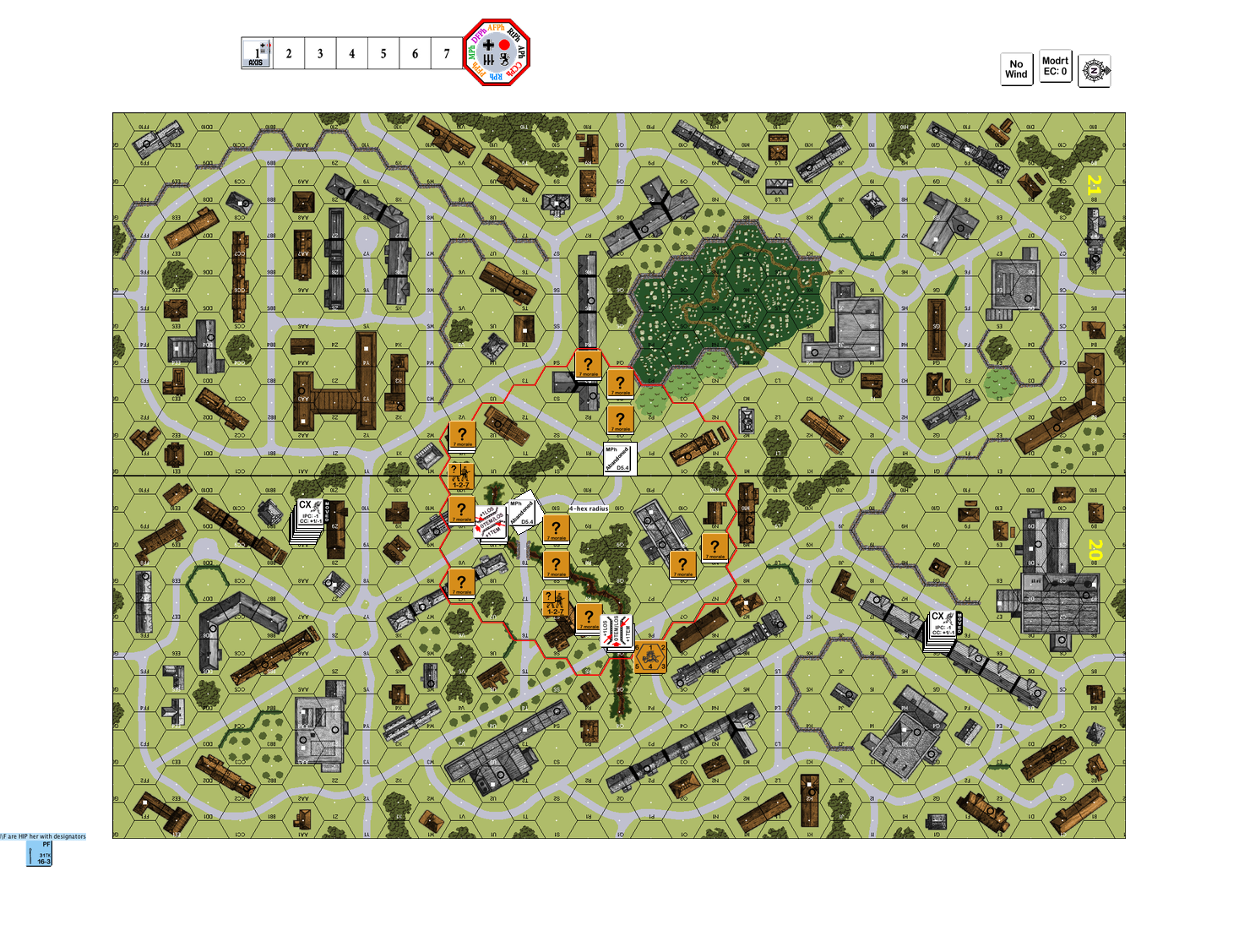
Erwin played the Imperial Japanese Army (IJA) and I the Rajputs of the British Indian Army.  The above illustration is the British Turn 1.  The IJA had already initiated their advance from the west.  The IJA’s winning condition was to amass more “victory points” (ie kill more) than the British and to occupy 5 or more huts (“the village”) on the top right of the map.  The two “TI” units you see are a mortar unit and a medium machine gun (‘MMG’) unit trying to dig foxholes in a grain field, looking to dominate the depression and to slow the IJA advance to the huts.  You can see also where the mortar bore-sighted  (the semi-transparent marker on the top left) and where the MMG bore-sighted (bottom right).  The IJA could choose to have reinforcements coming in from the top left of the map in Turn 2 or from the bottom right of the map in Turn 3.  In retrospect I should have weighted my defence more toward the top of the map where the approach to the huts was shorter.

IJA Turn 2

This is IJA Turn 2.  The IJA was already rushing the Rajput trenches.  There was a Banzai attack on the top left of the map where 2 IJA squads and a leader ran through all defensive fire and into a trench with a solitary Rajput squad.  These Rajputs fought valiantly and with their last gasp took ALL the offending IJAs with them in brutal hand to hand combat.  (Note to self: never put too many squads into a HtH, kill odds for BOTH sides are good.)

British Turn 2

The British Turn 2.  The IJA had already crumbled the top side of the Rajput trench defence but now it was clear that the IJA reinforcements would not be coming from the top left but from the bottom right on Turn 3.  The Rajput mortar squad fired off a smoke round to block the IJA mortar crew and the MMG crew on the opposite side of the depression.  The Rajputs from the trench line were in full retreat, desperately running across the depression.  The orchards in the depression provided a fair bit of cover.  The MMG squad was still trying to dig their fox holes amidst all the action upfront.  You should also see a British squad pinned on the bottom left before it could get into the depression.  These guys won’t survive the engagement.

JT3a-proc

IJA Turn 3 : The IJA was going for blood!  The IJA reinforcements appeared on the bottom right of the map.  The orchards provided good hindrance for them. In the meantime, the mortar and the MMG squads were busy firing away, as did the retreating squads in the depression.  The IJA arrived at the edge of the depression.  They were also on the verge of overrunning the routing Rajputs in the woods on the top of the map.

IJA Turn 4

IJA Turn 4 : the Rajput mortars took out an IJA 9-1 leader and a crew in the preceding British turn from across the depression with an airburst and so the IJA decided that it was time to lay a smoke round on them.  The MMG squad finally got their foxholes in the preceding turn.  You can see the IJA reinforcements coming to the woods line immediately south of the village (on the right of the map) where the IJA sniper broke the LMG crew in the hut on the south-eastern tip.
British Turn 4

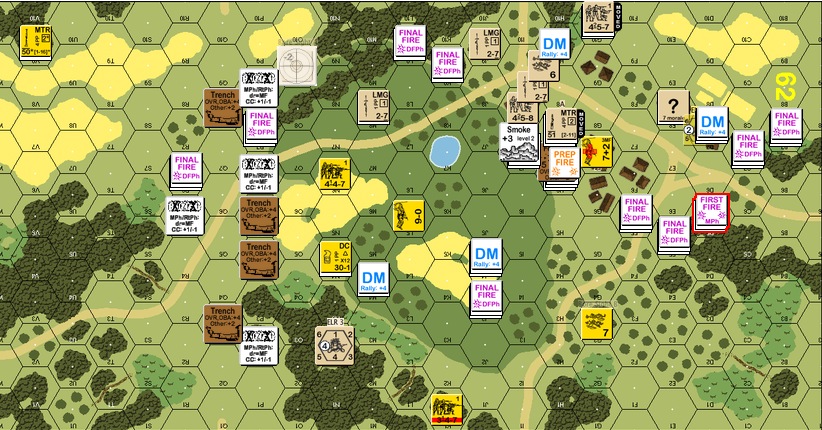
British Turn 4 : this was the last chance for the Rajputs to prepare for the inevitable IJA onslaught.  The game teetered on a balance at this point.   In the middle of the village, the IJA smoke round actually protected the Rajput mortar as it relocated to prepare for a last turn IJA rush.  The MMG in the foxhole kept the 3-hut cluster relatively clean (it would kill the injured IJA leader).  You can also see the IJA already moved into the Rajput LMG position on the south end of the village.

IJA Turn 5

Final IJA Turn : The good news from the last British turn was that the IJA fired at the broken stack in the hut on the north-west tip of the village and granted the Rajputs a battle hardened élite squad!  In this last IJA turn you can see all the residual fire on that corner of the village, evidence of the élite Rajputs (and the mortar squad) fighting hard.  The IJA broke into the south side of the village unfortunately.  Even though the Rajputs routed some broken squads forward in the last turn as speed bumps, they weren’t much good in the IJA Advance Phase (having routed off already).   The IJA won this scenario when the dust settled with a 1 point lead in VP and five huts secured.

To be honest, I didn’t read and understand the Victory Conditions properly.  I thought the IJA had to get more than 5 huts so I biased my defence towards the northwest of the village.  I was going to let the IJA have five huts but deny him the rest.  I succeed at that but unfortunately all they needed was 5.

If I play this scenario again, I will bias my trench line defence to the top of the map.  It’s also important that the trench line Rajputs retreat as fast possible to help with the village defence.

This was a tight scenario all the way to the end.  The action was brutal, the fight was desperate and the body count high.  For those who wants to experience PTO without the PTO terrain, this is a top notched scenario.

By 13 December, the 5/7 Rajputs of the British Indian Army commanded by Lieutenant Colonel R. Cadogan-Rawlinson, the last Commonwealth troops on the mainland, had retreated to Hong Kong Island.

– “Battle of Hong Kong“, Wikipedia

jaL80

English: Entry of the galleries from Shing Mun...

English: Entry of the galleries from Shing Mun Redoubt, part of the Gin Drinkers Line in Hong Kong Français : Entrée de l’une des galeries souterraines de la Shing Mun Redoubt qui faisait partie de la ligne fortifiée Gin Drinkers de Hong Kong (Photo credit: Wikipedia)

Rajput Regiment

Rajput Regiment (Photo credit: Wikipedia)

A Moment in ASL: Imperial Japanese Army in Hand-to-Hand Combat

Dead Japanese personnel lie where they fell on...

Dead Japanese personnel lie where they fell on Attu Island after a final “banzai” charge against American forces on May 29, 1943 during the Battle of Attu. (Photo credit: Wikipedia)

So here we were, right at the opening of DB99 The Gin Drinker’s Line. Indian troops were sitting in trenches on a windy mountain pass, staring down advancing IJA troops bent on breaking through the last defence line between them and the capture of the entire Kowloon peninsula (Hong Kong).

At a particular trench, defensive fire broke and routed two Indian squads from the trenches. A squad nearby advanced into the trench hex. IJA troops kept moving in and it was too late to get into the trench. One IJA squad broke through the grain fields straight up front, our squad pinned it down with First Fire. Good. Another IJA half squad raced by to the right and Subsequent First Fire failed to bring them down. The Indian squad was now out of guns and wishing for the enemy Movement Phase to end.

From the swirling mist to the left, an IJA 8-0 leader at the tree line thrust his sword into the air and screamed : BAAAANNNNZZZZZZZAAAAAAAAAIIII!!!

Two IJA squads pour out of the forest with the 8-0, running straight for our Indian squad.  Staring Death in the eye, the Indians invoked Final Protective Fire, survived the Morale Check but failed to knock back the IJA horde.

The Indians were locked in Close Combat with two IJA squads and a 8-0. With 2-1 Hand-to-Hand odds and the IJA -1 DRM, a DR of 10 would wipe the Indians out (92% probability). Sure enough, IJA rolled a 7.

With death being a certainty, the Indians decided to take on all comers. Hand-to-Hand combat at 1-2 odds calls for a dice roll of 6. Since they were fighting the IJA, they needed a 5.

Our squad rolled 1 & 3. 

They took the 2 IJA squads and the 8-0 leader down with them.

Brian Youse pointed out the dangers of Hand-to-Hand (HtH) combat in his article “The Case for Infiltration” (ASL Journal 3).

It is not a good idea to commit too many IJA troops to a HtH combat because of the high chance of mutual destruction. In our case H-t-H allowed the “dying” Indian squad to take out 1 IJA squad with a die roll of 6 (42% probability) vs 4 in normal close combat (17%), or 2 IJA squads with a die roll of 5 (28%) vs 3 in normal close combat (8%).

This is an important note to self.

jaL80


S1 Retaking Vierville – as the Germans This Time!!

Turn 1 American Movement Phase

Turn 1 American Movement Phase

General Eisenhower speaks with members of the ...

General Eisenhower speaks with members of the 101st Airborne Division on the evening of 5 June 1944 (Photo credit: Wikipedia)

A lot of us has played this Advanced Squad Leader Starter Kit scenario a few times before.   This infantry only scenario offers a purist’s exercise in fire and manoeuvre.  It also offers both sides the opportunity to attack and to defend.  It is my default warm up scenario with any new PBeM opponent, a chance for us to learn about each other before we embark on more complex scenarios.

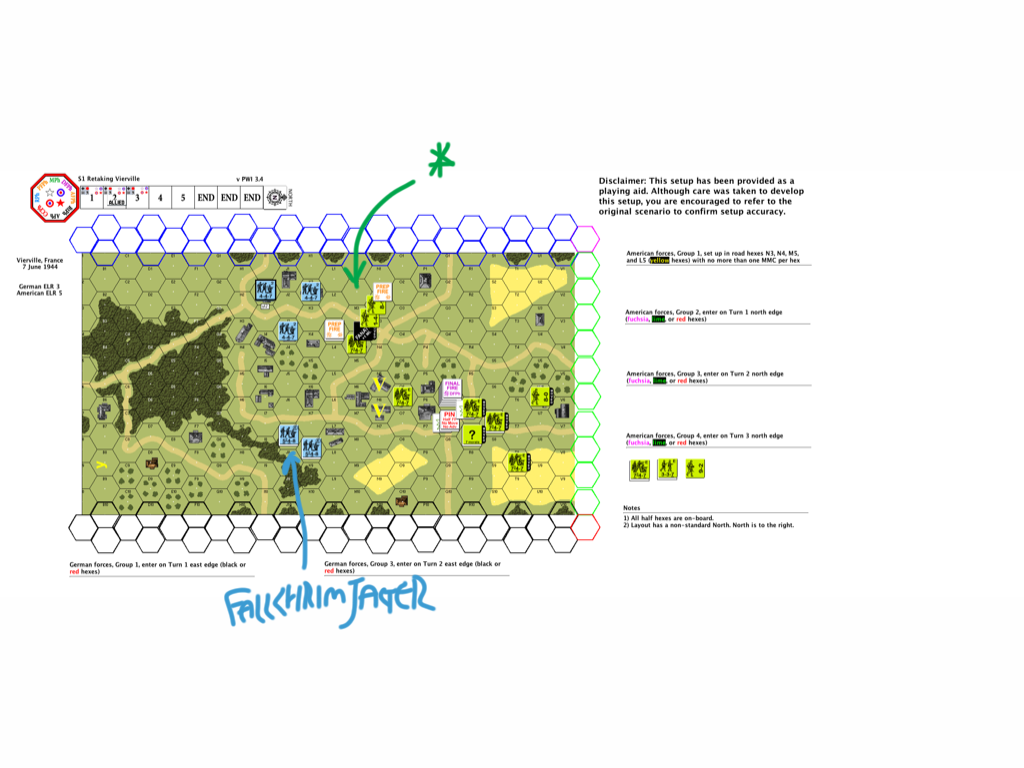
This time I play the Germans and we played with Advanced Squad Leader rules (not Starter Kit rules).  In the picture above you see the Germans (blue counters) having returned to the village from the west (top) and the east (bottom).  The American 101st Airborne (green counters) reacted by scattering to the buildings on both sides of the key interaction.  Some of the American reinforcements had already appeared to the north (right).

As the Germans, the mission for the 1058th Grenadiers in the east (bottom) is to use the open ground to delay the American reinforcements as much as possible.  The mission for the 919th Grenadiers is to do the same from the west (top).  They were to buy enough time for the tough 6th Fallshirmjäger (paratroopers) Regiment to arrive from the east and take at least one of the four key buildings (circled in red) in the intersection to fulfil this scenario’s winning requirement.

Turn 3 German Movement Phase

Turn 3 German Movement Phase

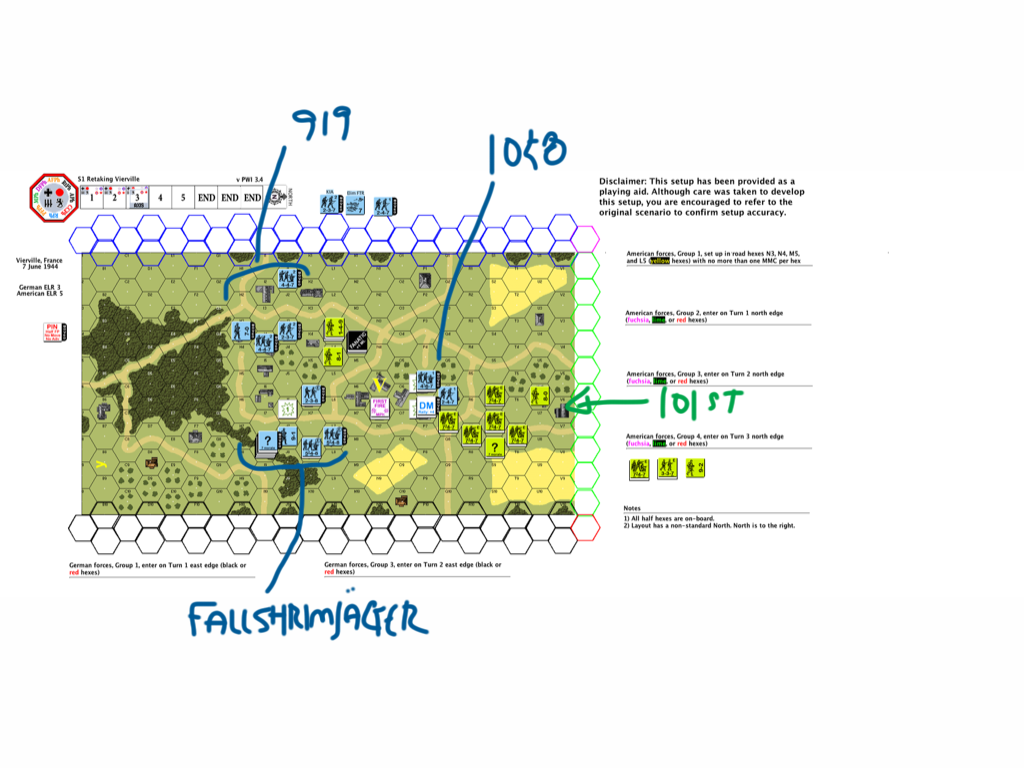
Buildings P2 on the top (right) of the map and R7 on the bottom (right) of the map proved to be invaluable in delaying the Americans (both marked in yellow).  At the same time the newly arrived 6th Fallschirmjägers planned to isolate the left side of the battlefield from buildings K6 & K8 (circled in red).  Their  compatriots made the first of three attempts to storm across the street into the key buildings to the right of the intersection.  The Screaming Eagles‘ fearsome firepower would make that an exercise in futility.  The other German paratrooper platoon sped up the woods on the left towards the top of the map.

Turn 4 German Movement Phase

Turn 4 German Movement Phase

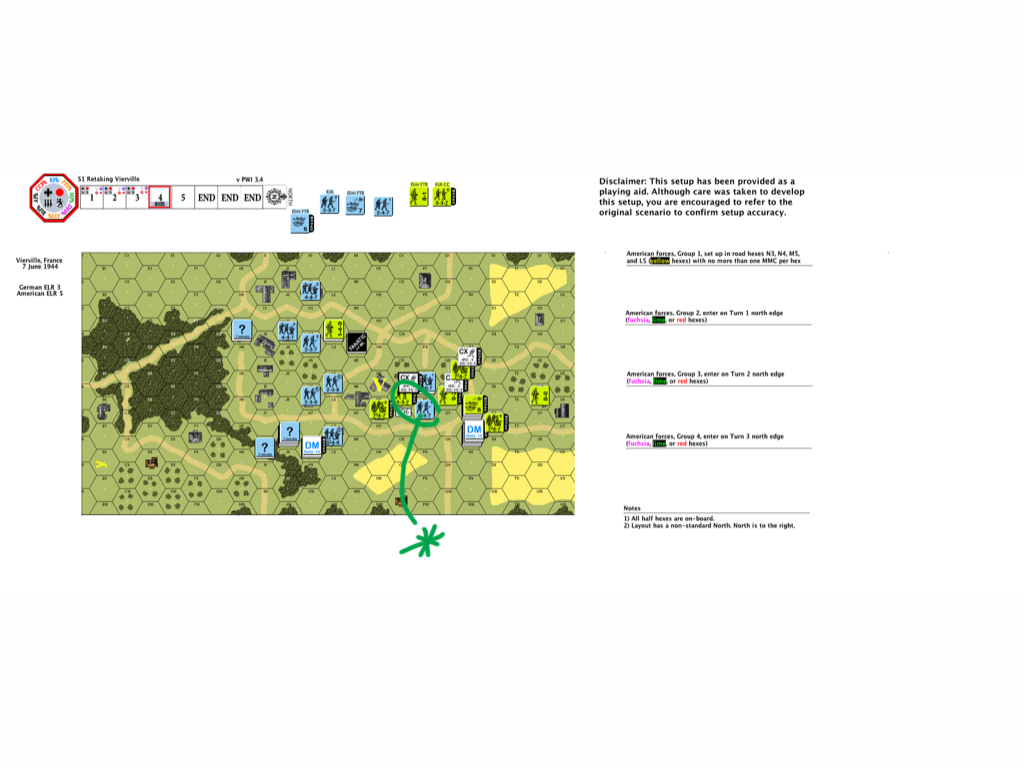
Again the German paratroopers on the bottom of the map stormed across the street.  The 1058th Grenadiers to the right of that building cluster provided diversion.  They were still holding the American reinforcements at bay across the open fields though.  The squads in building P1 (top) and R7 (bottom) held strong.  A Fallschirmjäger platoon was making its way to the top of the map where the Americans in the two key buildings on the southwest (top) of the battlefield felt increasingly isolated.

Turn 5 American Movement Phase

Turn 5 American Movement Phase

This is the last Movement Phase in the game.  The Germans paratroopers succeeded in capturing one (red) of the four key buildings on the map in Turn 4, thus already fulfilling the victory conditions.  The American reinforcements on the right went all out.  The German squads in our top and bottom stone buildings fought a desperate fight but were very thankful of their training in the use of spraying fire.

They held on.

There’s a great deal of material on the internet around this scenario:

I am on more than a few PBeM scenarios at the moment.  Some of which has to do with the PTO even, just in time for the release of Rising Sun.  When they finish you’ll be the first to see the AARs.

Take care!  

ge548Sam747S

Should I Stay Or Should I Go? Probabilities in Advanced Squad Leader.

American soldier awaiting German counterattack

American soldier awaiting German counterattack (Photo credit: Za Rodinu)

I still remember my Grade 9 math classes on Probability. Those classes are perhaps one of the most useful ones I ever had. My teacher took all the most common casino games and lotteries schemes and had us calculate the probabilities of different outcomes for each. You can imagine how delightfully interesting that semester was.

One result is that I don’t gamble all my adult life because we proved to ourselves mathematically that the house ALWAYS win.

Probability plays a huge part in Advanced Squad Leader through the use of dice rolls (“DR”). As with life, different decisions carry different levels of risk and are reflected through the use of dice rolls in the ASL world. Grognards I play with have probability tables committed to memory.

So what does this all translate to?

A Light Machine Gun (“LMG”) rate of fire is “1”.  That means LMGs have a 16.67% chance of firing again and a 2.78% chance of firing 3 times. For Heavy Machine Guns (“HMG”) with their rate of fire of “3”, their chances of being able to fire again goes to 50%. There’s a 25% chance of the HMG being to fire the third time.  If you take into the account that HMGs malfunction at a DR of 12, the probability of HMGs being able to fire a third time without malfunctioning is 22.97%.

Think of that the next time your squad face one down.

Sniper rules in ASL are interesting. For some, it stops us from firing off every squad on the board when the odds of shots having any effect is low. However, the probability of a DR triggering a SAN and for the sniper to active is actually pretty low. A SAN of 4 gets triggered only 3 out of 36 possible outcomes with two dice. You need a further roll of 1 or 2 on a single die for that sniper to be active.  End result? A SAN of 4  triggers a sniper with some effect only 2.78% of the time.

I read Mr. Robert Medrow’s excellent article “First Impressions – A Introduction to Advanced Squad Leader : Infantry Training” almost a year ago when I first looked to learn the game. It didn’t hit me much at the time. A big stack of games afterwards, it certainly does. It’s in Avalon Hill The General Magazine, Vol 22 Number 6.

Take a look at Mr. Medrow’s Table 5 “Probability that a single unit will survive and attack either unharmed and unpinned or (unharmed and pinned)”. One of the games I am currently playing has SS troopers (Morale level 8) attacking 1st Line Russian squads (Firepower 4). That means if a SS squad run across the open, its chances of survival is 49% (Table c). Those opportunities are hard to come by however, if the squad decides to Assault Move on open ground, its chances of survival is 60%.  If I can’t hit it while on the move but try to shoot at it during my Prep Fire, its chances rise to a whopping 94% sitting in some stone buildings!  However while I have 6% chance of doing anything to it, I have only 0.93% chance of being sniper bait (German SAN 2). I might just go head and take the shot anyway, for lack of better alternatives.

On the contrary, my Russian squads are fine 91% of the time sitting in stone buildings against inherent firepower from the SS squads.  They have a 84% chance against an HMG firing once but a 70.6% against HMG being able to fire twice, which is 50% of the time.  Against HMG firing 3 times (25% probability), their survival dropped to 59.3%.  That is lower odds than squads getting caught in the line of fire while skulking – 64% against inherent firepower.

See how much fun it is? Plus that’s just with one of Mr. Medrow’s probability tables. Every action in ASL carries with it the inherent benefits and risk. It’s the optimisation of these choices that makes Advanced Squad Leader so perpetually engaging!

Resources :

Grognards Speaks : Advanced Squad Leader Articles That Change Their Lives

Detail: Espinoza Tawed Skin/Parchment model

If you are a Advanced Squad Leader player and you are not on online forums such as GameSquad yet, I suggest you do. You will find a terrific community of ASL’ers discussing rules, giving their reviews on scenarios and products. You will find a lot of support and from time to time, a better alternative to eBay in acquiring Advanced Squad Leader modules and Third Party Products.

Lately the grognards discussed ASL training articles that changed their (ASL) lives. This is obviously too good of a thread to pass up, so here it is:

This is the original thread on GameSquad forums.  I hope this helps you as much as it helps me!

Do let me know however of articles that helped you!

G15 Bone of Contention – Partisans vs Retreating German SS

On 31 August 1944, the SS-Panzer Abteilung 102, Waffen SS’s heavy tank division retreated towards Germany after a 20 day stand at Hill 112 near Caen (see Operation Jupiter).  In the map above the left most marker is Utah, second one from the left is Omaha, Hill 112 is the 2nd from the left and Rouen is the one to the left.

The division was almost destroyed by the heavy fighting and had to abandon their tanks at Rouen by the shore of the Seine.  On the night of August 31, a team of soldiers, mechanics and tankers crossed back to the western shore of the Seine to destroy the abandoned tanks.  Amongst the wrecks they found two abandon Panthers sitting immobile, with  local partisans trying to figure out the mechanical beasts.

The German’s mission was to destroy the two Panther’s and the partisans, the BCRA Maquis de Rouen, were to protect their prizes at all costs.

Witchbottles played the Germans and I the partisans.  We got German conscripts and self rallying crew pitted against partisans who couldn’t form fire groups, has low ammo and tend to break toys easily.

This is the initial setup, and the north is on the right.  The partisans couldn’t stack and couldn’t be more than four hexes away from a specified hex.  I looked to use the gully as a protected passage between the forces to the east (bottom of the map) and their comrades on the south side (left of the map).  The Germans enter from the left and the bottom of our screen.  As it turns out, the Germans from the left took the direct route but the Germans from the bottom took a long detour around the partisans to the north.

As the turns progress, this flanking move would take the northern defenders off their prepared positions.

Over to the south (left), an all out street fight ensured.  The partisans tried to stay concealed for protection but took every opportunity to snapshot the Germans between the one hex buildings.

photo 2-2

To the north (right) the Germans outflanked the partisans and started to make their way to the Panthers, darting between the tombstones.

After the game, Witchbottles observed that he would have rushed forward to occupy the large stone structure to the upper right of the northern partisan forces, to the right of the graveyard (dark green).  That would have secured the partisan’s northern flank, no doubts.

The German unit I marked off with a yellow circle and an arrow was the unit who managed to put a panzerfaust into the side of the Panther.  The partisans I marked off with rough dotted lines in the middle was the partisan squad that killed a German half squad with gunfire but attracted a sniper shot to the Panther on the top right (to the lower left of the dark green graveyard).  The shot that killed the partisan commander stunned the crew and they promptly abandoned their big toy.  One Panther burning, one Panther abandoned.

Turn 6 Axis AFPh - Killed Panther

A partisan squad managed to run to the graveyard walls and took a couple of shots at the approaching tank crew and promptly ran out of ammo.  The mechanics and crew realized they couldn’t get a good shot at the Panther from the graveyard and so they came over the walls.  In the German Turn 6 the game ended at the Advanced Fire Phase when the Germans nailed the second Panther.

In retrospect aside from moving to occupy the big stone building to the north and thus securing my northern flanks like Witchbottles advised, I should make better use of fire lanes and residual fire.  Next time!  You live and learn.

A big THANKYOU to Witchbottles for a very interesting game!

S1 (Part 1) Retaking Vierville

On June 7 1944, one day after the Normandy landings. the 101st Airborne (“Screaming Eagles”) was sorting themselves out from all over the Cotentin Peninsula and was tasked with securing the eastern approach to the American landing at Utah beach. Vierville-sur-Mer was a major traffic thoroughfare. Although the Americans secured it earlier they had to moved westwards towards the German strongpoint of St. Come du Mont (see Mission Albany).

There are three groups of symbols in this map of Normandy.  The one on the top left is Utah Beach, the one on the bottom left is St. Come du Mont which was a German stronghold.  The group to the right is Omaha beach and a bit inland from Omaha Beach is Vierville-Sur-Mer.

An assortment of German units took the opportunity to deliver a counterattack and among them, the elite 6th Fallschirmjäger Regiment. This day would see an all out brawl at Vierville-sur-Mer, paratroopers to paratroopers.

Erwin plays the Germans and I the Americans. We decided to play this Advanced Squad Leader Starter Kit Scenario with full Advanced Squad Leader rules. The Americans win if there are no “good order” German units in the four buildings marked with “V”s on the map. By the same token, the Germans need to keep a “good order” unit in at least one of the four buildings at game end (notice the Americans have the last move).

Turn 1 German - MPh

Turn 1 German Movement Phase

Some elements of the 1st Battalion, 506th Regiment of the Screaming Eagles were making their way through the center of town when German units (1058th & 919th Grenadier Regiments) appeared from different directions.   (Right edge of the map is North.)

The Americans went straight to work.  Two full squads and the  8-1 leader went to the key buildings in the southwest, the other elements went to the northeast to meet up immediately with the 1058th Grenadiers.  The southwest element could potentially be isolated and might find itself fighting a much tougher battle until  reinforcements arrive.  Their mission was to play for time.  The northeast element was to clear the way for the reinforcements and were free to play to their strength in the attack.

Turn 1 American - Close Combat Phase

Turn 1 American Close Combat Phase

Other American elements started to arrive.  They used the grain field (which is in season) to make it across the open ground, using a building for cover.  A potential danger was that new German elements might appear behind them and cut them off from their rout paths.  So one squad stayed behind in the woods as the rear guard (circled in orange on the map above).

Sketch 2013-06-22 18_27_32

Turn 2 American Movement Phase

A broken American squad on the south west decided to step it up, rallied and went fanatic (battle hardened, marked by the asterick). In their desperation, a hero arose in their midst!  The reinforcing Screaming Eagles lost no time in closing with the 1058th Grenadiers on the northeast.  Hellbent on blasting their way through, they also drew fire away from their brothers who followed.  The German paratroopers arrived from the south east as well.  They carefully made their way through the woods towards the sounds of battle.  (Right edge of the map is North.)

Sketch 2013-06-22 18_40_09

Turn 3 German Advance Fire Phase

The 919th Grenadiers crossed the street in the south-west and pressured the squads on that corner of the intersection.  At the same time the 6th Fallshirmjäger moved to slice the battlefield in half, isolating the 8-1 and his little group.  To the north (right edge of the map), the Screaming Eagles couldn’t break through the 1058th Grenadiers.  They needed to clear a way to town fast ‘cause the key buildings are falling to the Fallshirmjäger soon, which also means they and their arriving brothers would all be standing outside the grain field with no protection if they couldn’t get into town.

Sketch 2013-06-22 18_45_21-1

Turn 4 German Rally Phase

The Screaming Eagles managed to get into close combat in the north.  A half squad was killed when they went in for hand to hand with a German squad and their 8-1 leader.  On the other side of the block an American half squad ambushed their German counterpart when they broke into their building.  The Americans slipped through to the other side and met up with the American paratroopers that were holding the Fallshirmjägers at bay.  However the American’s hold on the key junction was strained as they endured volleys after volleys of German fire.

So here we are at the start of Turn 4 in a 5 turn scenario.  Will the Germans succeed in capture at least one of the buildings at the intersection and hold off American attacks?

am747Sge548S

How about coming home everyday to 30 mins of PBeM game over VASL?

Whether you are a fellow newbie who would like to learn together or an experienced ASLer who don’t mind helping me up the curve. I play to enjoy and to learn. Please message me at jackson-dot-kwan-at-gmail-dot-com!!

Google

DASL1 The Schoolhouse – Team Play

Photo taken early game

Last Sunday I spent the afternoon playing DASL1 The Schoolhouse.  I was thankfully partnered up with an experienced ASL’r, Simon, as the Russians.

This engagement took place on July 9 1943 at a Russian village at the Kursk salient called Ponyri.  The scenario card described this as “the most intense street fighting since Stalingrad“.  This engagement also saw the huge Ferdinand tank destroyer (aka “Elefant “or “Porsche Tiger”) in action.

I got to say : this is a VERY interesting scenario. The Germans (Lawrence, Erwin & Wah) had limited time before a whole new Russian army piled in. On one hand they needed to be aggressive as they were under time pressure, although they couldn’t be too aggressive as they had to be able to fall back to proper defensive positions when the Russian counterattack arrived.

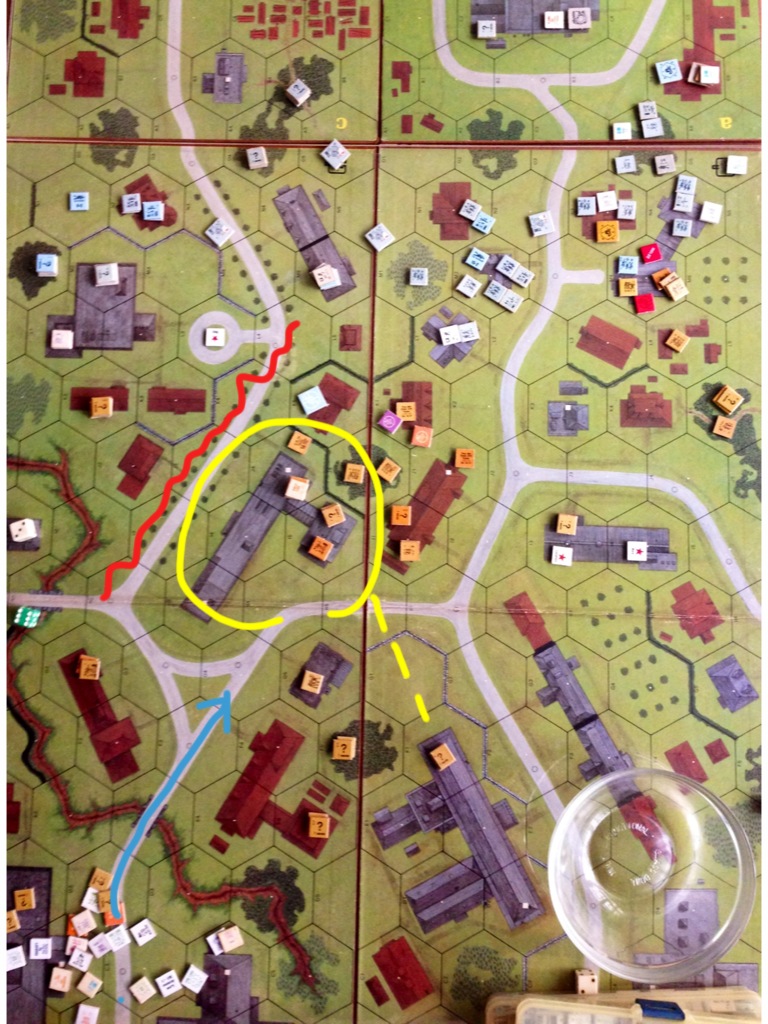
My partner Simon did a terrific job defending the stone building (marked in yellow) to the immediate north of the intersection on board d. His use of  tunnels (one of them marked with yellow dotted line) to the two buildings behind (forfeited fortified buildings) as rout paths and to gain concealment was a beautiful thing to see. Too bad the Germans lost their flamethrower early in the game!!

The Russian defence involved the use of set demolition charges as well. The Russians fell back when necessary but did everything to delay the Germans until the counterattack arrived. One of the Elephants was torched with Molotov Cocktails when it tried to rush a killer stack. Two of the remaining three Elephants were immobilized but were in great positions. It didn’t look easy for the counterattacking Russian tanks if they want to hit back through the narrow streets.

The Germans tried rushing the street (marked with the wavy red line) in front of the stone building but was wiped out by spraying fire.  At one point the Germans got that stone building encircled, rush the ground floor and was in the process of destroying one end of the tunnels.

That was precisely when the counterattack showed on Turn 7 (marked with the blue arrow).

The lead tanks and the elite troopers of the 1st Battalion 1032nd Rifles helped defend the tunnels together with the 307th Rifles coming back through. I had to run at that point but my friends told me there was a human wave on the German’s left flank and Germans conceded on Turn 8.

How about coming home everyday to 30 mins of PBeM game over VASL?

Whether you are a fellow newbie who would like to learn together or an experienced ASLer who don’t mind helping me up the curve. I play to enjoy and to learn. Please message me at jackson-dot-kwan-at-gmail-dot-com!!

Google

RPT1 (Part 3) Ferenc Jozef Barracks – A View of Advanced Squad Leader Scenarios

Turn 2 Hungarian - PFPh

Turn 2 Hungarian – PFPh

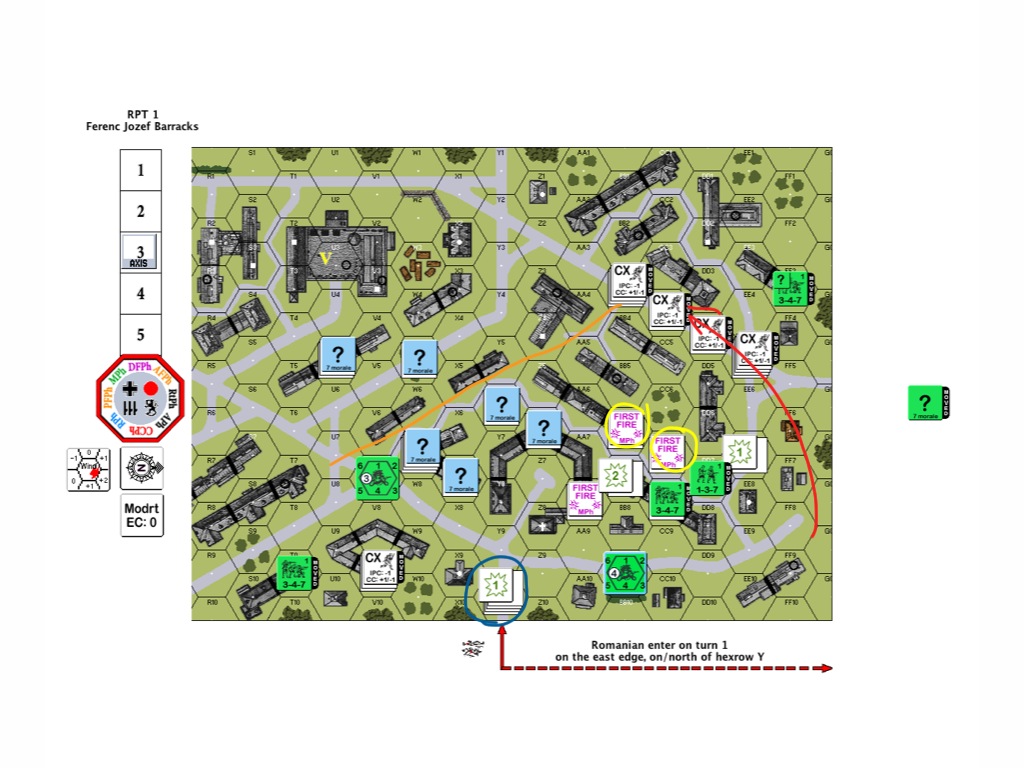
We are back on RPT1 Ferenc Jozef Barracks.  Just so everyone remembers, the Romanian 9th Cavalry were the attackers and the Hungarian 1st Tank Division were the defenders.  This engagement was part of the horrendous 100 day siege of Budapest.  The Hungarians were fighting along Nazi Germany and the Romanians were Russian allies.  The goal of the scenario is for the Romanians to capture the barracks (marked with a yellow “V” by Don) seen on the top left of the map within a 5 turn (10 mins in real world) time frame .

Turn 2 Hungarian

The above was what it looked like at the start of the Hungarian Turn 2.  The Hungarians started moving back towards the barracks while keeping their guns pointed to areas where their Romanians pursuers would need to cross.

Turn 2 Hungarian DFPh

Turn 2 Hungarian DFPh

The Romanian 9-2 squad leader hiding all along together with a squad and a shiny new medium machine gun (in the middle on the bottom, circled in orange) decided it was the best time to come out of concealment and open fire at the Hungarians who came into sight.  Unfortunately the MMG went the way of the flamethrower and clonked out on the first volley!  Apart from making a mental note to launch a complaint against the armoury after the engagement there wasn’t a lot he could do.  The other chaps in the building to the bottom right heard the ruckus and joined in as well but they then realised they no longer had line of sight.

The Hungarian defenders did a beautiful job slipping away towards the barracks whilst staying in concealment.  (Note to self : watch & learn)

Turn 3 Romanian

Turn 3 Romanians DFPh

Turn 3 Romanians DFPh

The Romanians orchestrated a series of moves in the hopes of stopping the bulk of the Hungarians from reaching the barracks.  On the righthand side of the map, the Romanians successfully kept the 2 Hungarian squads (circled in yellow) distracted while they double-timed a number of squads up the boulevards to the west.  They also intended to engage and even kill a few of the Hungarian squads by hand to hand combat where they could.

On the bottom of the map, the fuming 9-2 squad leader and his squad (circled in blue) who were dragging their broken MMG across the street (Note to self: use “Dash” next time) got pinned under heavy fire.  So there they were, hugging the ground and cursing up a storm in the middle of the street.

The orange line through the street on top was where the Romanians planned to shoot at the Hungarians who would need to cross over to the next building on their way to the barracks.

Turn 3 Hungarian RPh

Turn 3 Hungarian RPh

The Romanians (circled in red) tried to grab a couple of the escaping Hungarians, but in both instances they were ambushed instead!  The Hungarians decided to withdraw and slipped away while the Romanian attackers were still hugging their guns in fright.

So here we are at the start of the Hungarian Turn 3.  The Romanians have only 2 turns left and the Hungarians has done an elegant job in slipping away intact as a force while mostly staying under concealment.

Will the Romanians catch up to the Hungarian masters of defence?  Keep an eye out for Part 4 of RPT Ferenc Jozef Barracks!

hu347Sax347S


How about coming home everyday to 30 mins of PBeM game over VASL?

Whether you are a fellow newbie who would like to learn together or an experienced ASLer who don’t mind helping me up the curve. I play to enjoy and to learn. Please message me at jackson-dot-kwan-at-gmail-dot-com!!

Google

How To Play Advanced Squad Leader With Anyone Anytime Anywhere

Young Tibetan Buddhist monks smiling and happy...

Young Tibetan Buddhist monks smiling and happy, double dorje room, Sakya Lamdre, Tharlam Monastery, Boudha, Kathmandu, Nepal (Photo credit: Wonderlane)

Unless you already know someone who plays Advanced Squad Leader and assuming that I perked your interest so far, one question must have crossed your mind or have even smothered that fledgling spark of interest already:

Who am I going to play with?

The good thing about Advanced Squad Leader is that the user base is very strong. It’s a niche market but the user base is enthusiastic, sociable and thanks to the Internet, connected. The Hong Kong Society of Wargamers for example, meets and plays regularly.

This might be where you realize that your issue is not one of people, but of time. We got careers. We got families. We got obligations. It’s not easy to get together regularly for games. For me who’s a novice (read: n00b) at Advance Squad Leader, I need LOTS of play time if I am ever going to be any good.

VASL is a platform developed by Rodney Kinney that provides virtual map boards, counters and mean of communication so that two players anywhere in the world can play each other in real-time or NOT in real-time.

Playing VASL “live” via VASL servers allows two players to be location independent. VASL by email allows two players to be TIME independent.

Using VASL to play ASL by email is known as “PBeM” or really “ASL PBeM”.  Let me explain.  An Advanced Squad Leader turn is broken down by phases, some phases are interactive, others are not.

  • Rally Phase (Non interactive)
  • Prep Fire Phase (Non interactive)
  • Movement Phase (Interactive)
  • Defensive Fire Phase (Non Interactive)
  • Advance Fire Phase (Non Interactive)
  • Rout phase (Non Interactive)
  • Advance Phase (Non Interactive)
  • Close Combat Phase (Interactive)

The interactive phases like the Movement Phase and the Close Combat Phase are phases where control needs to be passed back and forth a couple of times between the two players (and these are best parts of the game). This is where the game takes time. However, the non interactive phases can be sequential – one player can complete what he/she needs to do before passing “control” off to the other player – which makes these other phases quicker in execution.

As you move your counters around the VASL map, VASL records all your moves in detail to a log file. At appropriate points in a turn, you stop your actions and send that log file to your opponent. Your opponent opens your log file on his/her VASL program and playback YOUR MOVES step by step and he/she can stop the playback at any point to interject his/her actions when needed.  Your opponent will have his/her actions recorded on another log file and will send it back to you and you will then playback his/her moves.  The interactivity of the game is essentially time-shifted, along with any commentary (and taunts) that each player elect to insert between his/her actions.

So here we go : the question “Who am I going to play with?” should no longer stop you from diving into the Advanced Squad Leader world.  

You can:

  • Bribe your friends to play with you.
  • Join the good people at The Hong Kong Society of Wargamers who runs ASL games and tournaments regularly
  • Play anyone in the world “live” via VASL (and the VASL server)
  • Play anyone in the world at anytime via VASL PBeM

Questions?  Please let me know!

How about coming home everyday to 30 mins of PBeM game over VASL?

Whether you are a fellow newbie who would like to learn together or an experienced ASLer who don’t mind helping me up the curve. I play to enjoy and to learn. Please message me at hongkongwargamer-at-disroot-dot-org!!

Resources:

Google